While the world is engrossed in following the Epstein files, there are other, seemingly modest developments that actually carry major headlines about the future and the years ahead. On 2 February 2026, the United Arab Emirates signed a Comprehensive Economic Partnership Agreement with the Democratic Republic of the Congo, and a few weeks earlier, it announced a similar partnership with Angola. At first glance, these news items might seem ordinary amid the flood of attention around the Epstein case. Yet, a few important questions may reveal why the UAE is shifting its traditional focus from East Africa and the Horn of Africa toward Central and West Africa—specifically, why it is intensifying its economic partnerships with Zambia, the DRC, and Angola. The answer, before diving into details, lies in the fact that this geography in Africa currently represents the main arena of competition between the United States and China. The region stretching from northern Zambia to southern Congo forms the world’s largest copper and cobalt belt. In other words, it holds immense reserves of critical minerals—especially copper and cobalt—that will make it one of the most vital resource zones in the coming decade.
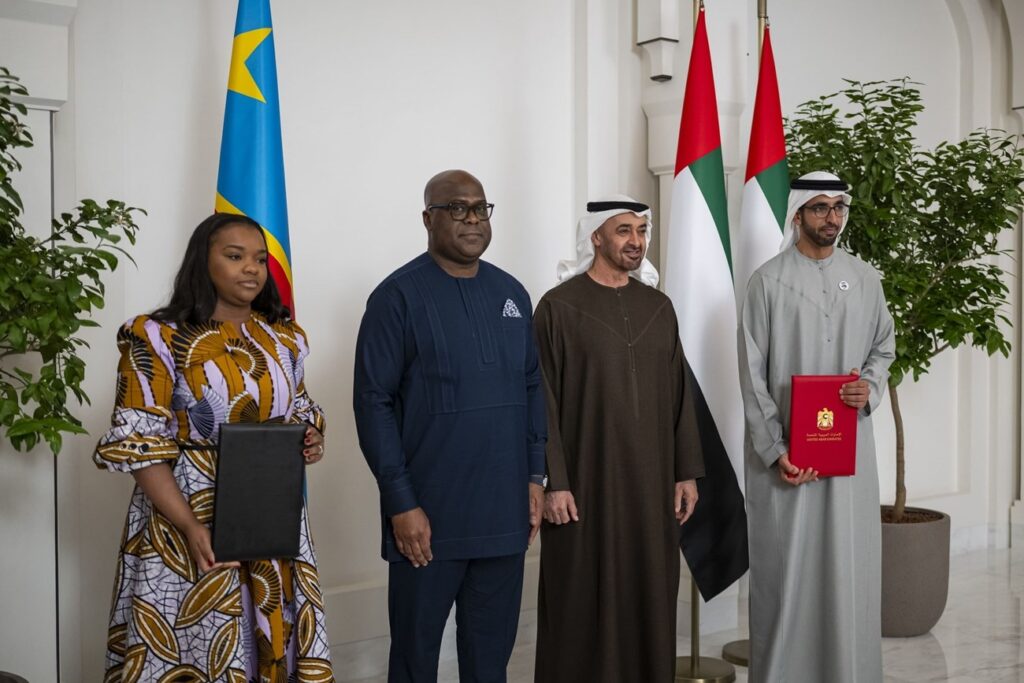
After consolidating its influence in East Africa, Abu Dhabi is now seeking to strengthen its foothold in Central and West Africa, with increasing focus on mining and clean energy infrastructure projects. In reality, this expansion of influence is not new—it did not begin with recent strategic agreement. For several years now, Abu Dhabi has been intensifying its presence in Africa’s mining sector, particularly in Zambia and the DRC.
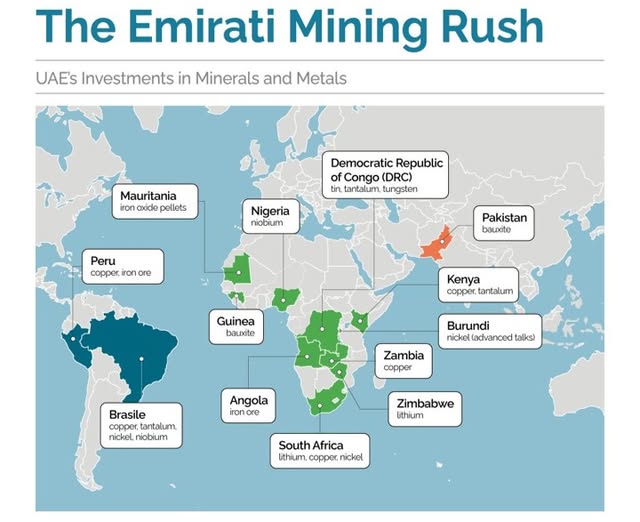
The UAE has acquired a majority stake in one of Zambia’s largest copper mines, as well as in one of the DRC’s richest Tin mines. It has also signed major deals to develop several critical-mineral mines in the same countries, along with a large-scale project for processing copper and cobalt.
The UAE’s ambitions go beyond major mining investments—it is also targeting strategic transport corridors that will carry the “fuel of the future” from Africa to the United States and Europe. The comprehensive economic partnership signed with Angola centers on developing Angolan ports along the Atlantic Ocean, which are set to become the new export gateways for Copper and Cobalt from Zambia and the DRC via the Lobito Corridor, reaching Angolan ports and from there to American and European markets. This route effectively challenges China’s dominance over the world’s largest copper–cobalt belt.
Yet, the UAE’s moves do not occur in isolation from the broader U.S.–China rivalry over critical minerals. On the eve of the UAE–DRC partnership announcement, Washington—through a government-backed consortium—revealed a huge $9 billion deal to acquire a 40% stake in Glencore’s mining investments in the DRC. This timing may be coincidental, but it speaks volumes about the broader story.
UAE’s involvement in aligns with U.S. efforts
The UAE’s growing involvement in Congolese mining aligns with U.S. efforts across Africa to counter Chinese control of critical minerals and to secure flexible, reliable supply chains away from Beijing’s reach.
Thus, Abu Dhabi’s vision appears to align with American strategic priorities, reinforcing the UAE’s value to Washington through investments in critical minerals that the U.S. ranks among its top priorities. At the same time, just as oil once served as a tool that boosted the regional and global influence of Gulf states, the UAE’s deepening partnerships in Central and West Africa—and its heavy investments in critical minerals—will help preserve its regional and international clout as it positions itself within the new global energy order.
Epstein’s files expose the secrets of power and control
Epstein’s files and other scandals will continue to expose the secrets of power and control in the world but meanwhile, the real story lies in the relentless efforts of powerful actors to dominate the sectors shaping the future decades. This is where attention must turn, for it is here that the secrets of the future are revealed—while the world remains distracted by the scandals of the past. The attached map shows Emirati mining investments across Africa, Asia, and Latin America.
Proof of Mossad’s presence in Libya
After the fall of the Gaddafi regime, Libya emerged as an “open cake” for redivision among various parties. In this context, we come across a secret message regarding the division of the cake between an Emirati family that is Zionized—the family of Maneh Saad Al Otaiba, father of the current UAE ambassador to Washington, Yousef Al Otaiba—and a Libyan family referred to as the Saad family.
The message was sent by a person named “Bill Konfr” to Epstein, informing him that a powerful group stands at the heart of the scene: an Emirati–Libyan alliance led by the Al Otaiba family from Abu Dhabi, in partnership with the Libyan Saad family. According to the message, this group was not just ordinary investors; it was a main financier of the rebellion, contributed to the establishment of the National Transitional Council (NTC), and then moved directly to seize key sectors of the Libyan economy: Banking, the national telecommunications company, oil services, food, cars, and heavy equipment.
The text of the message dated 6 March 2012 can be read as follows:
We are currently dealing with the Saad–Al Otaiba group regarding some potential deals in Libya. In short, this is the group coming out of Abu Dhabi that helped establish the National Transitional Council in Libya and was one of the main financial backers of the subsequent rebellion. The Al Otaiba family owns large stakes in the National Bank of Abu Dhabi, the National Insurance Company, the largest mobile phone company in the region, as well as oil services companies, and they represent many global brands. The founder of the group was president of OPEC for six terms. One member of the Al Otaiba family currently serves as ambassador to the United States. The Saad family is a Libyan expatriate family that has worked with the Al Otaiba family for decades as key advisors to many of their business interests.
The Saad family owned the largest oil services company in Libya before Gaddafi nationalized it. The Al Otaiba group will enter Libya in partnership with the Saad family as the local Libyan partner. So far, they have already deposited nearly a billion dollars in a bank they own in Libya, and they will soon take over the Libyan national telephone company through a long-term management agreement. They are also looking for partners and brands for other business sectors. They are interested in obtaining exclusive distribution licenses for a number of car and heavy equipment brands, including General Motors, Caterpillar, Mercedes, Volkswagen–Audi, Nissan, and others. They also plan to enter the food production sector i.e. pasta, dairy products, confectionery, etc and the oil services sector. They are looking for a joint venture partner for deep-sea offshore drilling to contract with the Libyan National Oil Corporation. In all business categories, they seek represent well-known brands in Libya or enter joint ventures. We will continue dealing with the Misrata business family we discussed with you previously for some deals, but the Saad–Al Otaiba group has far greater potential for success in major deals and representing global companies.
I will be traveling to the United States this week and hope we can meet when I arrive in New York.
(Document Number: EFTA00659624)
It is clear from the message that Epstein was indeed running business in Libya through a family in Misrata immediately after Gaddafi’s fall. This implicitly means that Mossad has been present in Libya since Gaddafi’s downfall.
Disclaimer: The opinions expressed in this article are solely the author’s and do not neccessarily reflect the opinions or beliefs of the website and its affiliates.