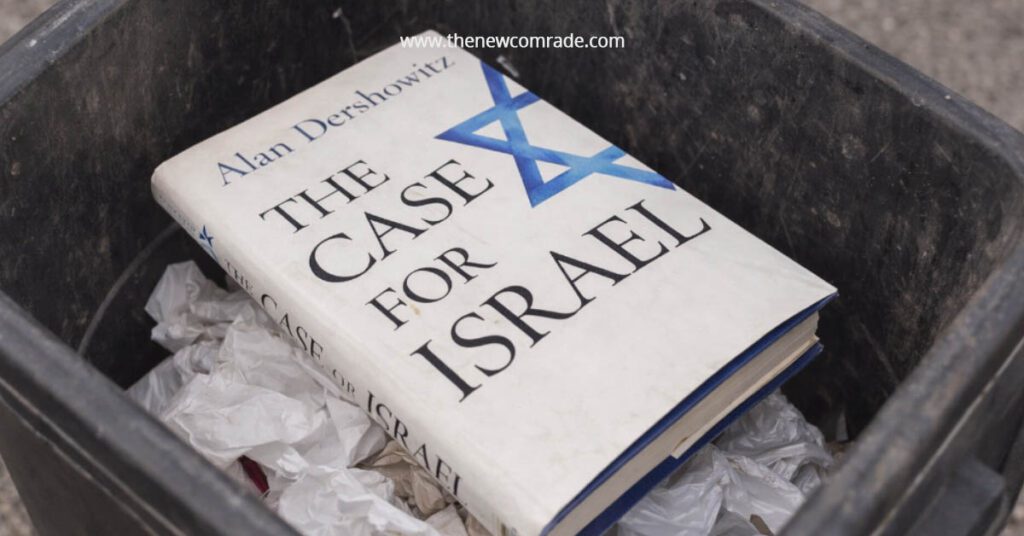
Alan Dershowitz’s The Case for Israel (2003) is a seminal text in the canon of pro-Israel advocacy, yet it is essential to categorise it correctly from the outset: it is a work of jurisprudence, not historiography. Dershowitz, a celebrated appellate lawyer and Harvard Law professor, approaches the Israeli-Palestinian conflict not as a historian seeking to reconstruct the past in all its complexity, but as a defence attorney representing a client accused of capital crimes. The book is structured explicitly to exonerate.
This review seeks to dismantle and nullify the major arguments presented in The Case for Israel. The central thesis of this review is that Dershowitz’s “case” relies on a specific rhetorical strategy: the “proactive defence.” This method involves framing historical events through a legalistic lens that prioritises exculpatory evidence while systematically excluding incriminatory primary data. By treating the history of the Middle East as a series of indictments to be quashed, Dershowitz constructs a narrative that is internally consistent but historically bankrupt.
The nullification of his arguments requires a forensic examination of his sources, his logic, and his omissions. As we shall see, Dershowitz often relies on secondary sources that have been discredited (most notably Joan Peters, From Time Immemorial: The Origins of the Arab‑Jewish Conflict over Palestine, Harper & Row, New York, 1984), misrepresents the conclusions of the “New Historians” (particularly Benny Morris), and employs a utilitarian moral philosophy that justifies state violence in ways that fundamentally contradict the international law he claims to uphold.

Epistemology of advocacy: Methodological flaws
To effectively review The Case for Israel, one must first critique its structural methodology. The book is organised into 32 chapters, each posing a specific “Accusation” (e.g., “Is Israel a Colonial, Imperialist State?”) followed by “The Reality” and “The Proof.”
Dershowitz’s primary rhetorical device is the formulation of the “Accusation.” By controlling the wording of the charge, he limits the scope of the rebuttal. For instance, he refutes the accusation that Israel committed “genocide” during the Second Intifada. By setting the bar at “genocide”—a specific legal term requiring intent to destroy a group in whole or in part—he easily refutes it by citing population growth statistics. However, this allows him to sidestep the actual substantive criticisms levelled by human rights organisations, such as “war crimes,” “collective punishment,” or “grave breaches of the Fourth Geneva Convention.” The nullification of his argument begins by recognising that he is answering charges that serious scholars are not necessarily making, while ignoring the charges they are making.
A recurring theme in the text is the “Jew among nations” theory—that Israel is judged by a standard not applied to other democracies or dictatorships. While the existence of bias in international forums is a valid discussion, Dershowitz weaponises this concept to deflect legitimate scrutiny.
The flaw in this logic is what logicians call the appeal to hypocrisy fallacy. Even if it were true that China or Syria commits worse human rights violations, this does not legally or morally absolve Israel of its specific obligations under international law as an occupying power. A murder suspect cannot demand acquittal simply because the court failed to prosecute a different murderer in the next town. Dershowitz attempts to use the “double standard” argument as a get-out-of-jail-free card for specific violations of the Geneva Conventions, an argument that holds no weight in actual international law.
Dershowitz frequently confuses “legal” with “just.” He spends considerable time arguing that the occupation is legal under the laws of war (a contested claim) or that the settlements do not violate Article 49 of the Fourth Geneva Convention (a claim rejected by the ICJ). He often asserts that because the Israeli Supreme Court has ruled a practice legal (such as house demolitions or “moderate physical pressure”), the practice is therefore consistent with the rule of law. This is a circular argument. The critique levelled by international bodies is that the Israeli judicial system itself facilitates violations of international law. Citing the domestic court of the accused nation as the ultimate arbiter of its own conduct is a jurisprudential conflict of interest that Dershowitz, as a lawyer, would never accept in an American courtroom.

Foundational myth: Nullifying arguments on 1948
The most critical section of Dershowitz’s book—and the one most vulnerable to nullification—is his treatment of the 1948 war, the creation of the refugee problem, and the nature of Zionism.
Dershowitz’s Argument: In Chapters 1 and 2, Dershowitz argues that Israel is not a colonial state because Jews are the indigenous people of the land, returning to their ancestral home. He asserts that early Zionists bought land legally and that the land was largely empty or “malarial swamps” before Jewish cultivation.
Dershowitz relies on a sanitised version of the “land without a people” myth. While he acknowledges an Arab population existed, he minimises it using data that appears to be lifted from Joan Peters’ From Time Immemorial—a book widely discredited by demographers like Yehoshua Porath for fraudulently claiming that most Palestinians were recent immigrants to the area.
Historical census data from the Ottoman Empire establishes that in the late 19th century, the Arab population was settled, distinct, and substantial (over 500,000). Dershowitz’s claim that Zionism was anti-colonial because it fought the British Mandate ignores the definition of “settler-colonialism.” As described by founding Zionist figures themselves (like Ze’ev Jabotinsky in The Iron Wall), the project was explicitly about establishing a majority in a land already populated by another people. Jabotinsky wrote, “Zionist colonisation… must either be terminated or carried out against the wishes of the native population.” By ignoring the explicit “colonial” terminology used by Herzl, Nordau, and Jabotinsky, Dershowitz engages in historical revisionism.
Chapter 12 contains the book’s most significant scholarly failures.
Dershowitz’s Argument: He posits that the 700,000 Palestinian refugees were not expelled by Israel. Instead, he argues the “displacement was a result of a war started by the Arabs” and that Arab leaders ordered the Palestinians to leave to clear the way for the invading armies. He cites Benny Morris to support the claim that there was “no Jewish design” to expel the population.
Dershowitz’s use of Benny Morris is a textbook example of “citation mining”—extracting a quote while ignoring the context that contradicts the advocate’s thesis.
1. The “Arab Orders” Myth: Dershowitz resurrects the claim that the Arab Higher Committee or Arab radio broadcasts ordered the Palestinians to flee. This claim was debunked decades ago by researchers like Erskine Childers and Walid Khalidi, who analysed BBC transcripts of Middle East broadcasts from 1948 and found no such orders. In fact, they found orders from Arab commanders telling civilians to stay put. Even Benny Morris, whom Dershowitz cites, states clearly in The Birth of the Palestinian Refugee Problem that he found “no contemporary evidence” of a general Arab order to flee.
2. The Misrepresentation of Benny Morris: Dershowitz quotes Morris saying there was “no guiding hand” (i.e., no Master Plan like a blueprint) for expulsion. However, he omits Morris’s crucial findings that constitute the bulk of his work: that the IDF implemented “Plan Dalet,” which gave brigade commanders discretion to clear villages. Morris documents that in the majority of cases, flight was caused by “military assault,” “expulsion,” “fear of Jewish attack,” and “whispering campaigns.”
3. Specific Nullification: On page 81, Dershowitz claims, “The tiny Jewish state was in danger of being overrun.” He uses this to justify the chaos. Yet, he ignores the IDF Intelligence Service Report of June 30, 1948, which analysed the causes of the flight. That internal Israeli document attributed over 70% of the refugee flight to direct Jewish military operations (hostile operations and expulsion orders). Dershowitz does not engage with this primary document because it nullifies his “voluntary flight” thesis.
Dershowitz’s Argument: He admits the Deir Yassin massacre (April 1948) occurred but frames it as a tragic anomaly committed by “dissident” militias (Irgun and Lehi), condemned by the mainstream Haganah and Ben-Gurion. He argues it was an exception that proves the rule of Israeli purity of arms.
This is a gross minimisation of the tactical utility of massacres in 1948.
1. Not Isolated: Historians have documented dozens of massacres, not just Deir Yassin. These include Al-Dawayima (where estimates of dead range from 80 to over 100), Eilabun, Safsaf, and Lydda. In Lydda (July 1948), under the command of Yigal Allon and Yitzhak Rabin, Israeli forces killed hundreds and forcibly expelled 50,000-70,000 civilians on foot in the heat of summer. This was a regular army operation, not a “dissident” militia action.
2. The “Atrocity Factor”: Dershowitz ignores the psychological warfare strategy. The Haganah exploited the news of Deir Yassin. As Morris notes, they utilised vans with loudspeakers warning other villages that “Deir Yassin will happen to you if you don’t flee.” By presenting Deir Yassin as a singular moral failing rather than a strategic lever used to induce panic and flight, Dershowitz falsifies the historical record.
Dershowitz’s Argument: He argues that allowing refugees to return would be “national suicide” for Israel and that there is no precedent for a “fifth column” population returning to a country that they fought against. He equates the Palestinian flight to the population exchange between India and Pakistan or the expulsion of Jews from Arab lands.
Dershowitz conflates “immigrant absorption” with “repatriation rights.”
1. International Law: UN Resolution 194 (Article 11) resolves that “refugees wishing to return to their homes and live at peace with their neighbours should be permitted to do so.” Dershowitz dismisses UN resolutions as non-binding or biased, but this resolution was a condition of Israel’s admission to the UN.
2. The “Jewish Refugees” Equation: Dershowitz argues that the expulsion of 850,000 Jews from Arab lands cancels out the claims of 700,000 Palestinian refugees—a “population exchange.” This is a moral and legal category error. The victimisation of Iraqi or Egyptian Jews by the Iraqi or Egyptian governments is a crime chargeable to those governments. It does not forfeit the private property rights of a Palestinian farmer in Jaffa. One human rights violation does not legally liquidate the rights of a separate victim group. By treating ethnic groups as monolithic blocks to be traded on a ledger, Dershowitz engages in collective punishment logic, violating the principle of individual human rights.
While chronologically later, this argument is foundational to Dershowitz’s claim that Palestinians are “rejectionists” who do not want a state.
Dershowitz’s Argument: He repeats the Ehud Barak/Bill Clinton narrative: Israel offered Arafat 97% of the West Bank and all of Gaza, with a capital in East Jerusalem, and Arafat rejected it with violence (the Second Intifada).
This narrative has been dismantled by participants in the negotiations, including Robert Malley (US negotiator) and Shlomo Ben-Ami (Israeli Foreign Minister).
1. The “97%” Myth: The “generous offer” did not include 97% of the total West Bank. It excluded East Jerusalem and the Latrun salient from the calculation. Furthermore, Israel demanded to annex major settlement blocs (splitting the West Bank into cantons) and maintain control over the Jordan Valley for nearly a decade.
2. Sovereignty vs. Autonomy: The offer at Camp David denied Palestinians sovereignty over the Temple Mount (Haram al-Sharif) and airspace. It was, in the words of Ben-Ami later, an offer that “it would have been impossible for any Palestinian leader to accept.”
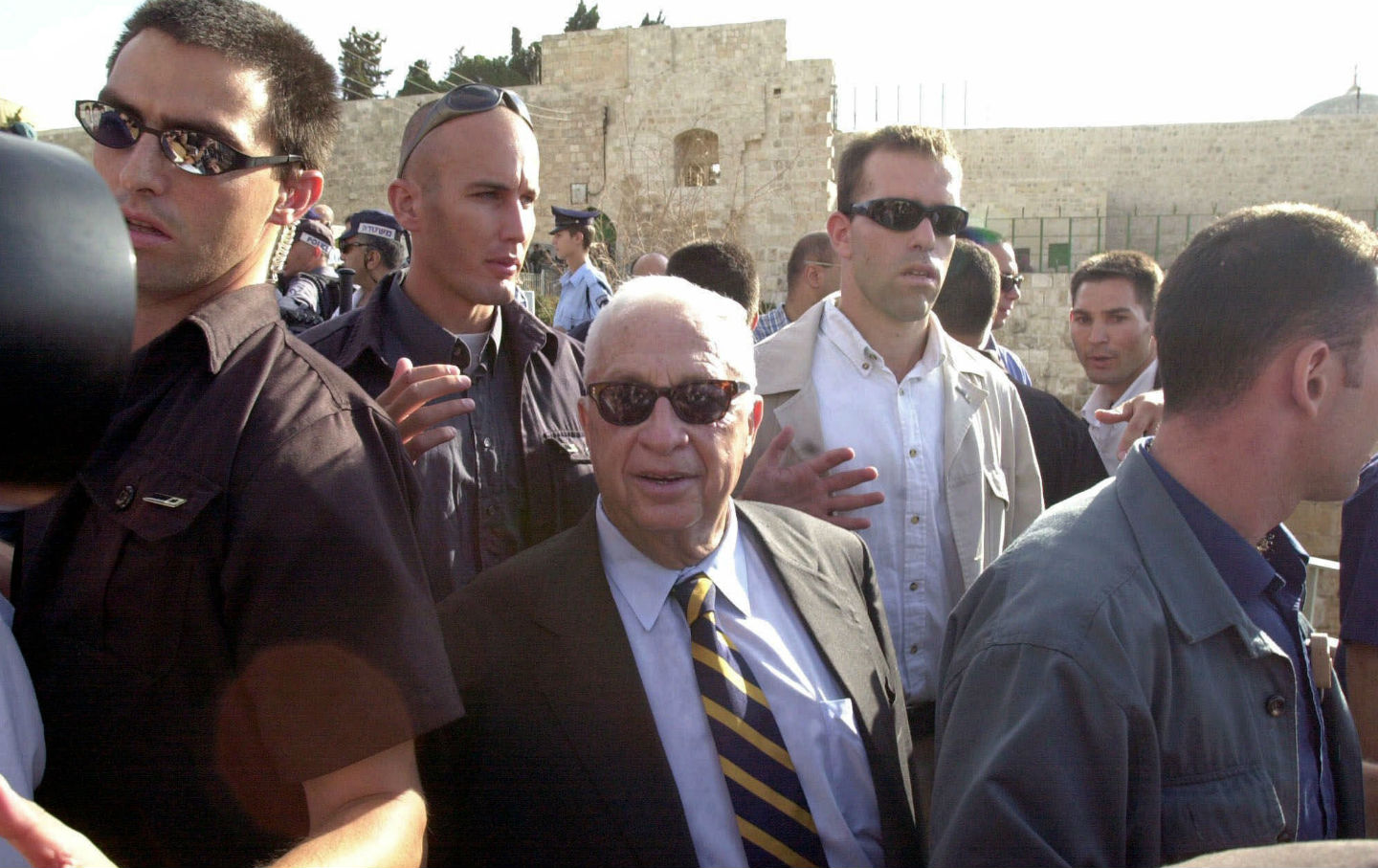
3. The Intifada: Dershowitz claims Arafat planned the Intifada as a response to the offer. The Mitchell Report (a US-led fact-finding committee) investigated this claim and concluded there was “no evidence” the Intifada was pre-planned by the PA. It was a spontaneous uprising triggered by Ariel Sharon’s visit to the Temple Mount and the subsequent lethal response by Israeli police. Dershowitz’s adherence to the “Arafat started the war” narrative is crucial for his defence of Israel’s subsequent military crackdowns, but it contradicts the findings of international investigators.
Asymmetry of terror: Deconstructing definitional defence
In the middle chapters of The Case for Israel, Dershowitz pivots from historical reconstruction (1948) to a defence of Israel’s contemporary security policies. His argument rests on a rigid, binary classification of violence: Palestinian violence is “terrorism” (and therefore illegitimate, criminal, and devoid of political context), while Israeli violence is “counter-terrorism” or “defence” (and therefore legitimate, even when it results in civilian death).
Dershowitz’s Argument: In Chapters 13 through 16, Dershowitz attempts to define terrorism strictly as “the deliberate targeting of civilians to achieve political goals.” He contrasts this with Israeli military actions, which he argues target combatants but occasionally cause “collateral damage.” He asserts a moral chasm between a suicide bomber who aims to kill a child and an IDF pilot who aims for a terrorist leader but accidentally kills a child.
While the distinction between intent and inadvertence is a standard principle in the Laws of War (specifically the principle of distinction), Dershowitz’s application of it ignores the legal concept of recklessness and disproportionality.
1. State Terrorism: Dershowitz categorically rejects the concept of “state terrorism.” However, international legal scholars argue that when a state employs military force in a way that creates foreseeable, massive civilian casualties to induce political capitulation or “deterrence,” it functionally mirrors terrorism.
2. The Dahiya Doctrine: Post-2006 (and evident in policies leading up to it), the Israeli military articulated the “Dahiya Doctrine”—the use of disproportionate force against civilian infrastructure to deter enemy populations. This is a state strategy that targets the civilian mind-set through destruction. By ignoring Israeli military doctrines that explicitly utilise “disproportionate force” (a violation of Protocol I of the Geneva Conventions), Dershowitz constructs a false binary. When an F-16 drops a one-ton bomb on an apartment block to kill a single militant, knowing with near certainty that civilians will die, the moral distinction between “targeting” and “collateral damage” collapses into criminal negligence (indirect intent).
A critical omission in Dershowitz’s taxonomy of terror is the violence perpetrated by Israeli settlers.
The Reality: Since the 1980s (the “Jewish Underground”) through the Second Intifada, armed settlers have attacked Palestinian civilians, burned olive groves, and committed shootings.
Dershowitz treats settler violence (like the Hebron massacre by Baruch Goldstein) as the act of “deranged individuals” or “extremists,” whereas he treats Palestinian violence as systemic and cultural. This is an analytical double standard. The settler movement is state-subsidised, IDF-protected, and politically integrated. By failing to categorise systemic settler harassment and violence as a form of “terrorism” (violence against civilians for political/territorial goals), Dershowitz biases the “case” to present Israel solely as the victim of terror, rather than a state hosting its own perpetrators.
Law of war: Nullifying “double standard” defence
Dershowitz’s most famous argument is that Israel is the “Jew among nations”—singled out for condemnation despite having a better human rights record than its neighbours.
Dershowitz’s Argument: He spends chapters listing human rights abuses in Egypt, Jordan, Syria, and Saudi Arabia. He asks: Why does the UN condemn Israel for targeted assassinations when Russia flattens Chechnya? Why does the world focus on Jenin when massacres occur in Sudan?
This argument is logically fallacious and legally irrelevant.
1. Jurisdictional Specificity: Israel is condemned not because it is “Jewish,” but because it is the world’s only prolonged military occupier claiming to be a Western democracy. The legal framework governing Israel (The Fourth Geneva Convention relative to the Protection of Civilian Persons in Time of War) creates specific obligations for an Occupying Power that do not apply to a sovereign state suppressing an internal rebellion (like Russia in Chechnya) in the same way.
2. The Ally Argument: Israel receives more US aid (military and economic) than any other nation (at the time of the book’s publication). Taxpayers in the West and international bodies scrutinise Israel precisely because it is integrated into the Western diplomatic and military sphere. The “double standard” is, in fact, a “standard of alliance.” We do not expect Syria to adhere to liberal democratic norms; Israel claims it is a liberal democracy. Dershowitz wants Israel to be judged by the low standards of a dictatorship while enjoying the prestige and support of a democracy. He cannot have it both ways.
Dershowitz’s Argument: He repeatedly asserts that high Palestinian casualty counts are the fault of terrorists hiding behind civilians. “The death of these civilians is the sole responsibility of the terrorists who use them as shields” (p. 168).
This is a misstatement of International Humanitarian Law (IHL).
1. Commander’s Responsibility: Under IHL, even if one side uses human shields (a war crime), the other side is not absolved of the obligation to minimise civilian harm. The presence of a human shield does not render the entire area a free-fire zone. The attacking commander must still weigh the military advantage against the civilian loss.
2. Israel’s Use of Human Shields: Dershowitz conveniently omits that the Israeli High Court of Justice (HCJ) had to intervene to stop the IDF’s “neighbour procedure”—a practice where Israeli soldiers forced Palestinian civilians to knock on the doors of suspected militants or walk ahead of soldiers to check for booby traps. By focusing exclusively on Palestinian use of shields, Dershowitz hides the documented fact that the IDF used Palestinians as shields during the operation in Jenin and throughout the Second Intifada (as documented by Amnesty International and B’Tselem).
Torture warrants: A critique of judicial sanctioned violence
Perhaps the most controversial and intellectually dishonest section of The Case for Israel is Chapter 19, “Does Israel Torture Palestinians?” Here, Dershowitz moves from defence attorney to policy advocate, proposing a legal framework for torture.
Dershowitz’s Argument: He acknowledges that the Shin Bet (GSS) uses interrogation techniques but refuses to call them “torture.” He adopts the Landau Commission’s (1987) terminology of “moderate physical pressure.” He argues that because Israel does not use “lethal” methods (like the rack or electric shock), it is not torturing in the medieval sense. He posits the “ticking bomb” scenario: If a terrorist knows where a bomb is that will go off in an hour, is it not moral to use non-lethal physical pressure to save 100 lives?
1. Definitions Matter: The UN Convention Against Torture (which Israel ratified) defines torture as any act by which severe pain or suffering, whether physical or mental, is intentionally inflicted. The techniques Dershowitz defends—”shaking” (which caused the death of Harizat in 1995), sleep deprivation, “shabach” (tying to a small chair in painful positions), and loud music—meet the international definition of torture.
2. The “Ticking Bomb” Myth: Empirical evidence from the Shin Bet archives and human rights reports shows that these methods were not reserved for rare “ticking bomb” scenarios. They were used routinely on tens of thousands of detainees to extract confessions about past events, organisational structures, or political affiliations. The “ticking bomb” is a philosophical thought experiment that Dershowitz uses to justify a bureaucratic system of routine abuse.
Dershowitz’s Argument: He argues that since torture happens anyway in the shadows, it should be brought into the light of law. He proposes that interrogators should have to seek a “torture warrant” from a judge, who would authorise the pressure only in extreme cases. He claims this would reduce torture by adding judicial oversight.
This argument is dangerously corrosive to the rule of law.
1. Legitimising the Taboo: By creating a legal mechanism for torture, the state validates the act. It transforms torture from a crime (even if committed in desperation) into a state-sanctioned bureaucratic procedure.
2. Judicial Complicity: History (including the US post-9/11 experience) shows that when judges are asked to sign warrants for “national security,” they almost always defer to the intelligence agencies. A “torture warrant” system would not limit torture; it would provide legal immunity to torturers.
3. The “Slippery Slope”: The Landau Commission allowed “moderate pressure” in 1987. By the late 1990s, the Public Committee Against Torture in Israel (PCATI) estimated that 85% of Palestinian detainees were subjected to these methods. Dershowitz’s argument that legalisation leads to less abuse is empirically false in the Israeli context. The normalisation of “pressure” led to its widespread use against non-ticking bombs (e.g., stone throwers, political organisers).
Dershowitz’s Argument: He cites the 1999 Israeli Supreme Court ruling that banned certain interrogation methods as proof of Israel’s robust democracy. “Israel is the only country… whose judiciary actively enforces the rule of law against its military.”
He omits the critical loophole in that very ruling. While the Court banned the routine use of these methods, it left open the “necessity defence” (protection from criminal liability) for interrogators who use force in “ticking bomb” situations. As B’Tselem has noted, the “necessity defence” became the new rubber stamp. The Shin Bet continued to use these methods, simply claiming “necessity” after the fact. Dershowitz presents the ruling as the end of the story; in reality, it was a rebranding of the practice.
Targeted assassination defence
Dershowitz’s Argument: In Chapter 17, he defends “targeted killings” of terrorist leaders. He argues this is consistent with the laws of war (targeting enemy combatants) and is preferable to massive ground invasions. He dismisses the criticism that these are “extrajudicial executions.”
1. The “Combatant” Definition: International law distinguishes between “combatants” (uniformed soldiers) and “civilians.” A civilian loses protection only “for such time as they take a direct part in hostilities.” Israel expanded this definition to include political leaders or those who “planned” past attacks, effectively creating a category of “illegal combatant” that allows them to be targeted anytime, anywhere (e.g., in their beds, with their families).
2. Due Process: By bypassing arrest and trial—even in areas like the West Bank where Israel exercises effective military control and could arrest suspects (as they do nightly)—Israel utilises assassination as a convenient alternative to justice.
3. Collateral Damage: The assassination of Salah Shehade (2002) involved dropping a one-ton bomb on a dense apartment block, killing Shehade but also 14 civilians, including 9 children. Dershowitz argues this was a “mistake” or “intelligence failure.” However, the pilots and commanders knew the bomb’s capacity. The willingness to sacrifice 14 civilians to kill one suspect violates the principle of proportionality. The “Case” for such tactics relies on devaluing Palestinian civilian life to a ratio that would be unacceptable if the civilians were Israeli.
Geography of control: Nullifying “benevolent occupation”
In the final substantive chapters of the book, Dershowitz attempts to defend the legality of the Settlements (Chapter 26) and refute the “Apartheid” analogy (Chapter 23). His strategy here is one of legalistic obfuscation: he redefines international statutes to fit Israeli policy, rather than assessing policy against the statutes.
Dershowitz’s Argument: He argues that Israeli settlements in the West Bank are not illegal. He contests the applicability of Article 49 of the Fourth Geneva Convention, which states: “The Occupying Power shall not deport or transfer parts of its own civilian population into the territory it occupies.” Dershowitz employs a restrictive “originalist” interpretation, arguing that this clause was written solely to prevent Nazi-style forced transfers. He contends that because Jewish settlers move “voluntarily,” Article 49 does not apply. He further argues that the West Bank is “disputed,” not “occupied,” because there was no sovereign Palestinian state prior to 1967.
Dershowitz’s interpretation of Article 49 is rejected by the International Court of Justice (ICJ), the United Nations Security Council (UNSC), the International Committee of the Red Cross (ICRC), and the vast majority of international legal scholars.
1. State Facilitation: While individual settlers may move voluntarily, the State of Israel plans, funds, subsidises, and protects these settlements. The state confiscates land, builds infrastructure, and provides military defence. This constitutes a state action to “transfer” population, violating the Convention.
2. The Goal of Article 49: The purpose of the convention is to protect the local population from colonisation and permanent demographic change by the occupier. Dershowitz’s interpretation would render the protection meaningless, allowing any occupier to colonise conquered land as long as they offered financial incentives rather than using gunpoint.
3. The “Missing Sovereign” Fallacy: The argument that the West Bank is not occupied because Jordan (the previous administrator) renounced its claim is a legal red herring. The rights in the Geneva Convention belong to the people (the protected persons), not the displaced sovereign. The Palestinians remain “protected persons” under occupation, regardless of the territory’s prior status. By denying the applicability of the Geneva Convention, Dershowitz attempts to strip Palestinians of their only legal shield against dispossession.
Dershowitz’s Argument: In Chapter 23, “Is Israel a Racist State?”, Dershowitz refutes the apartheid analogy by focusing almost exclusively on Israel proper (pre-1967 borders). He lists the rights of Arab citizens of Israel: they vote, they have representatives in the Knesset, and they serve on the Supreme Court. He concludes: “The situation of Arabs in Israel is fundamentally different from that of blacks in apartheid South Africa” (p. 157).
This is a geographic sleight of hand. The primary accusation of apartheid—levelled by Human Rights Watch, Amnesty International, B’Tselem, and scholars like Rashid Khalidi—refers to the regime of control over the West Bank and Gaza, not just the status of citizens in Tel Aviv.
1. The Two-Tiered Legal System: In the West Bank, two populations live on the same land but are subject to two different legal systems based on their ethno-national identity. A Jewish settler who commits a crime is tried in a civilian court in Israel with full due process rights. A Palestinian neighbour who commits the same crime is tried in a military court with a conviction rate of over 99%. This fits the definition of the Crime of Apartheid under the Rome Statute: “an institutionalised regime of systematic oppression and domination by one racial group over any other racial group.”
2. Infrastructure of Separation: Dershowitz defends the “Security Fence” (Chapter 24) as a defensive measure against terror. However, he ignores the route of the barrier. The International Court of Justice (2004) ruled the wall illegal not because Israel lacks the right to build a border fence, but because 85% of it was built inside the West Bank, annexing land and water resources. It is a tool of annexation and segregation, separating Palestinian farmers from their land, not just Israel from terrorists. By ignoring the map, Dershowitz ignores the crime.
Sources of authority: Joan Peters controversy
A critical review of The Case for Israel cannot ignore the forensic destruction of its scholarly integrity by critics, most notably Norman Finkelstein in Beyond Chutzpah (2005). This is not merely a matter of academic footnotes; it reveals the fraudulent foundation of Dershowitz’s historical narrative.
The Accusation: Dershowitz denies that he plagiarised from Joan Peters’ discredited 1984 book, From Time Immemorial. He claims he went to the primary sources himself.

The textual evidence suggests otherwise.
1. The “Turnspeak” Error: Joan Peters, in her book, mistakenly refers to George Orwell’s concept of “Newspeak” or “Doublethink” as “Turnspeak”—a word Orwell never used. Dershowitz, in The Case for Israel (p. 57 and p. 153), uses the exact same non-existent term: “George Orwell’s ‘turnspeak’.” The statistical probability of two authors independently inventing the same erroneous neologism while discussing the same topic is virtually zero. It indicates Dershowitz lifted the concept—and the error—directly from Peters without attribution.
2. The Mark Twain Quotation: Dershowitz quotes Mark Twain’s The Innocents Abroad to prove Palestine was empty. The quote contains a specific sequence of ellipses (omissions). Finkelstein demonstrated that Dershowitz’s quote matches Peters’ quote exactly, including the identical ellipses, down to the punctuation. This suggests Dershowitz did not consult Mark Twain; he consulted Joan Peters and cited Twain.
Reliance on Joan Peters is fatal to a historian’s credibility. Peters’ thesis was that “Palestinians” were actually recent Arab immigrants who swarmed into Palestine only after Zionists created economic opportunities. This thesis was debunked by demographic historians (including Yehoshua Porath of Hebrew University) as a “sheer forgery.”
By relying on Peters’ data and narrative framework (even if unacknowledged), Dershowitz adopts a fraudulent demographic model that aims to erase the indigenous status of the Palestinian peasantry. The “Case” he builds rests on the premise that there was no settled population to displace—a premise that is historically false. If the foundation is a fabrication, the legal argument built upon it collapses.
Verdict of history
Alan Dershowitz’s The Case for Israel is a masterclass in rhetoric, but a failure in history. As a legal brief, it is robust; it anticipates objections, attacks the credibility of witnesses (the UN, NGOs, Goldstone, etc.), and constructs a self-contained logic of innocence. However, history is not a courtroom where the goal is to create “reasonable doubt” to secure an acquittal. History requires the integration of all available evidence, even that which is inconvenient.
The ultimate failure of the book is what we might call the “Advocate’s Fallacy”: the belief that if one can construct a possible legal justification for an act, the act is therefore morally and historically justified.
• Dershowitz proves that one can interpret Article 49 narrowly to allow settlements—but fails to prove that this interpretation is accepted by the world or conducive to peace.
• He proves that one can define “torture” narrowly to permit “shaking”—but fails to address the human wreckage left by the Shin Bet’s dungeons.
• He proves that one can find quotes suggesting Arab leaders wanted refugees to leave—but fails to address the overwhelming evidence of Israeli expulsion orders.
To accept Dershowitz’s “Case” is to accept a world where:
1. The occupier is the victim.
2. International law binds everyone except the “Jew among nations.”
3. State violence is “defence,” while resistance is “terror.”
4. A people (Palestinians) do not exist as a demographic reality, but only as a “rejectionist” obstacle.
This review nullifies by exposing the intellectual dishonesty required to defend its specific policies of occupation and dispossession. Dershowitz’s book is a monument to the anxiety of the Zionist conscience in the 21st century: a frantic, brilliant, and ultimately deceptive attempt to reconcile the liberal values of the diaspora with the illiberal realities of the occupation. It is a “Case” that can only be won if the jury is sequestered, the witnesses silenced, and the evidence redacted. In the open court of history, the case is dismissed.