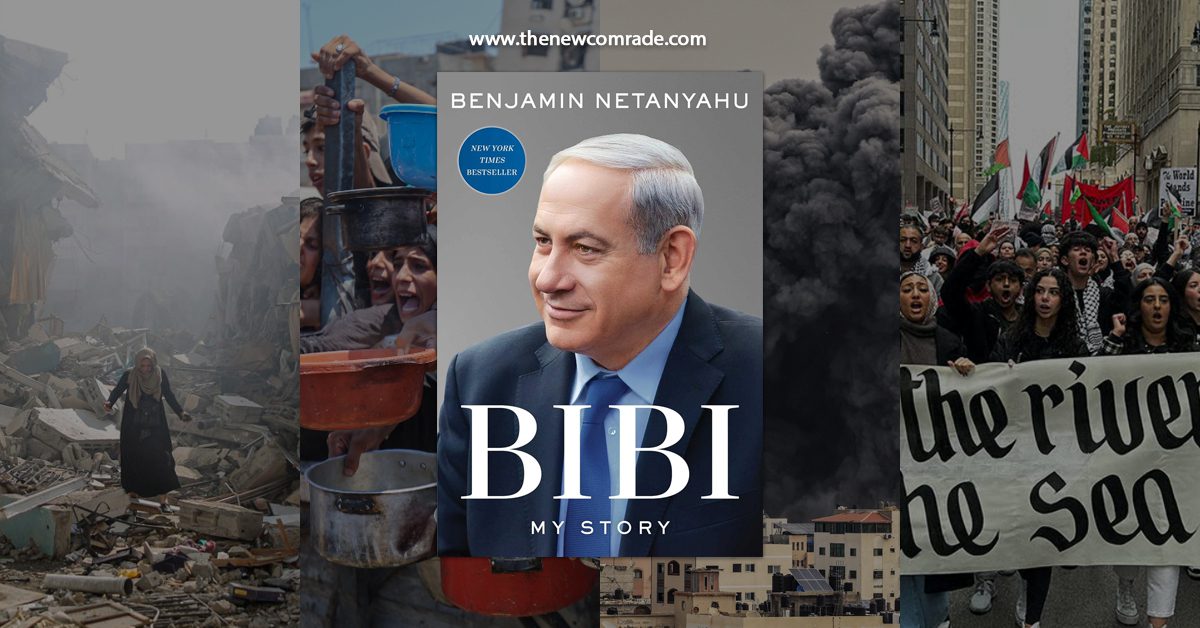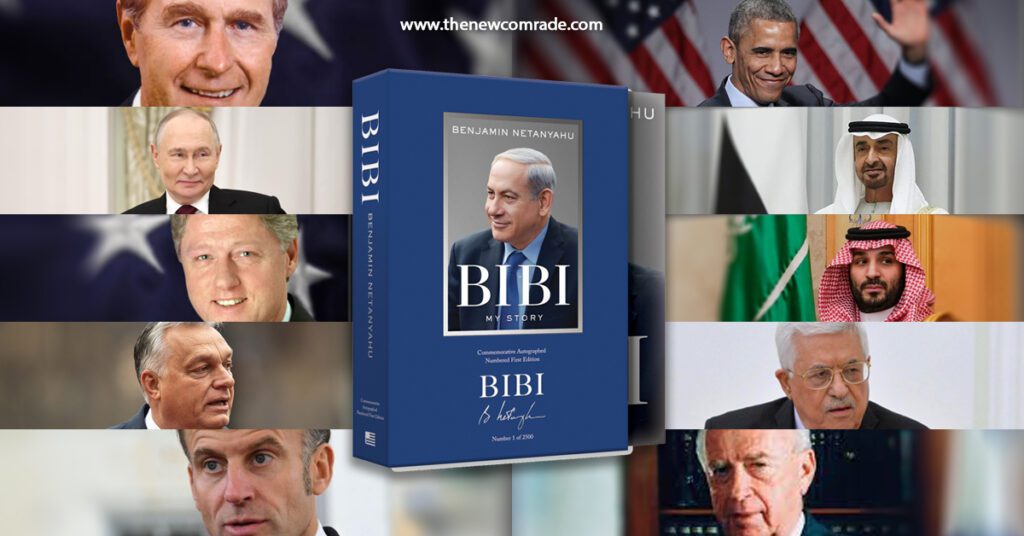
In his extensive autobiography Bibi: My Story, Benjamin Netanyahu does not merely recount his life; he constructs an expansive narrative of global power in which he is both the architect and the central figure. To understand his portrayals of world leaders is to decode the operating logic of what he terms the ‘Iron Wall’ philosophy — the conviction, inherited from Revisionist Zionist Vladimir (‘Ze’ev’) Jabotinsky, that his state survives not through the goodwill of neighbours or the benevolence of international institutions, but through the cultivation of overwhelming military, economic, and technological dominance.
His evaluations of the personalities he encountered over four decades in public life are rarely purely personal. They are, rather, clinical and instrumental. Netanyahu categorises world leaders according to their ‘strategic clarity’ — his self-coined term for the willingness to recognise what he describes as the existential threat of ‘radical’ Islam and the necessity of a sovereign, armed ‘Israel’. This framework, presented as hard-headed realism, is with its own presumptions, blind spots, and a barely concealed contempt for anyone who fails to endorse his worldview wholesale. The ‘realist’ Netanyahu is, in truth, a profoundly ideological figure who has dressed his politics in the language of security.
Throughout the narrative, Netanyahu assumes the role of a self-appointed tutor to the powerful, deploying historical analogies, oversized maps, and elaborate visual presentations to ‘correct’ the worldviews of those he perceives as naive. In doing so, he reveals less about those he describes than about his own consuming need to be the indispensable interpreter of West Asian reality for a Western audience that, by his reckoning, perpetually fails to grasp what is at stake. This paper proceeds through the four concentric circles of his world: The American presidents, the leaders of the East and of Europe, the Arab heads of state, and finally the domestic Israeli political figures against whom he has defined himself. Together, these portraits constitute an intellectual self-portrait of remarkable and troubling clarity.
Ronald Reagan
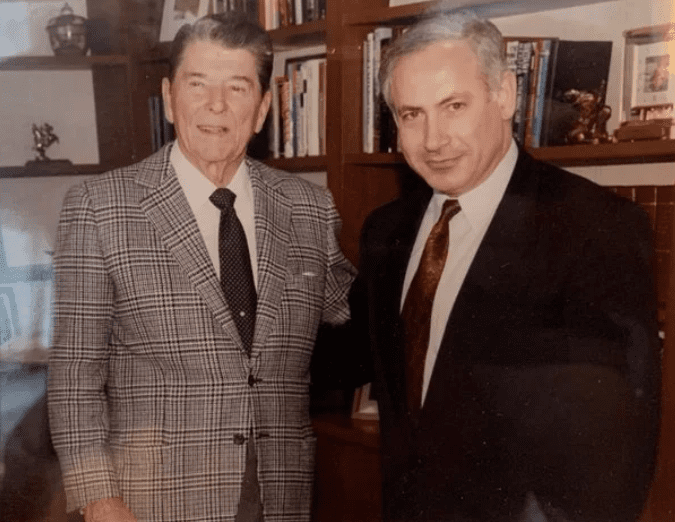
Netanyahu’s first major encounter with American presidential power took place during the Reagan era, a period he reflects upon with a reverence underpinned by a candid admission of early error. He confesses that when his father, the historian Benzion Netanyahu, proposed inviting Reagan to the 1979 Jonathan Institute conference on terrorism, the younger Netanyahu dismissed the suggestion on the grounds that Reagan was ‘merely an actor.’ Benzion’s rebuttal — that Reagan was a man of conviction whose instincts on geopolitics were sound — became a foundational lesson: never mistake a populist’s charm for intellectual shallowness.
Reagan, in Netanyahu’s formulation, represents the gold standard of Western leadership. What he admires is not Reagan’s domestic record — the deregulation that hollowed out American industry, the union-busting that impoverished the working class, the Iran-Contra affair that represented one of the most brazen violations of constitutional norms in post-war American history — but rather Reagan’s capacity to frame struggle against terrorism as a civilisational contest rather than a law-enforcement matter. Through his relationship with Secretary of State George Shultz, Netanyahu depicts himself as a significant intellectual influence on the Reagan administration’s evolving anti-terror framework. That this framework was used to justify support for some of the most brutal regimes and non-state actors of the Cold War era is a dimension that Netanyahu’s memoir studiously avoids mentioning explicitly.
The portrayal of Reagan as a man of ‘moral clarity’ is itself revealing. In Netanyahu’s vocabulary, moral clarity does not mean adherence to consistent ethical principles; it means alignment with Netanyahu’s own categorisation of allies and adversaries. Reagan, who supplied Saddam Hussein’s Iraq with military intelligence even as that regime deployed chemical weapons against Kurd civilians, represents an object lesson in how Netanyahu’s concept of moral clarity is, in practice.
George H. W. Bush: Institutional Friction
The transition from Reagan to the elder George Bush represents, in Netanyahu’s narrative, a shift from ‘ideological soulmates’ to ‘institutional adversaries.’ His portrayal of the Bush 41 administration is arguably the most strained in the book’s early sections, and it is here that the political methodology at the heart of Netanyahu’s career first becomes fully legible. Frustrated that the administration, led by Bush and Secretary of State James Baker, viewed his persistent media advocacy as obstructionist, Netanyahu chose to bypass the executive branch and cultivate direct relationships with Congress and the American public.
He depicts himself as ‘blacklisted’ from the State Department after publicly accusing the administration’s West Asia policy of being ‘based on lies and distortions.’ The episode illuminates something important: Netanyahu’s relationship with American democracy has always been transactional. When the executive branch did not serve Zionist policy preferences as he understood them, he turned to the legislature. When public opinion in Europe proved resistant, he cultivated the Evangelical Christian base in the United States. His fury at Bush’s demand that the Zionist entity refrain from retaliating against Iraqi Scud attacks during the Gulf War is presented as a matter of sovereign principle, though it sits alongside a broader pattern, in which Netanyahu invokes sovereignty selectively — demanding it for the Zionist entity whilst denying it to Palestinians.
William Clinton: Charisma and Capitulation
The Clinton years represent, in Netanyahu’s account, a more complex battlefield. He grants Clinton extraordinary personal attributes — charisma, political genius, an almost supernatural capacity for connection — while systematically demolishing the intellectual foundations of the peace process to which Clinton committed so much of his presidency. The Oslo Accords, in Netanyahu’s rendering, were a ‘slow-motion suicide pact,’ a phrase that encapsulates his entire approach to negotiated solutions with Palestinian leadership.
The most striking revelation of this section is Netanyahu’s account of the 1996 Israeli election, in which he claims that Clinton’s administration actively worked to secure a Shimon Peres victory. Netanyahu recounts that Clinton subsequently had the grace to acknowledge the effort and concede failure with something resembling humour.
Netanyahu respects Clinton’s ‘pragmatism’ while dismissing Clinton’s ‘Palestinian Centrality Theory’ — the broadly accepted diplomatic consensus that resolution of the Israeli-Palestinian conflict was essential to regional stability. He alleges the Clinton White House as being partial to the Palestinian narrative.
George W. Bush: Solidarity Through Tragedy
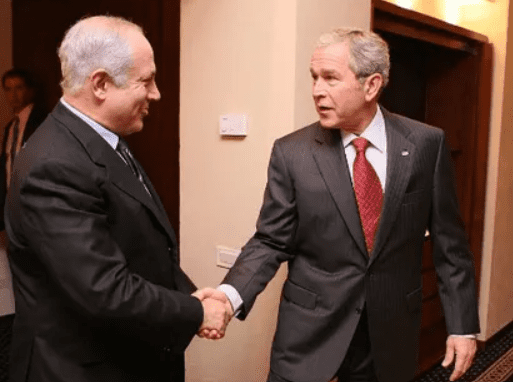
Netanyahu’s account of George W. Bush is cast in an overwhelmingly positive light, framed by the shared psychological geography of the post-September 11 world. Bush, like Reagan before him, is credited with ‘moral clarity’ — the willingness to name adversaries rather than negotiate with them, to frame the conflict in civilisational rather than political terms. Netanyahu portrays the Bush administration’s support for Ariel Sharon’s ‘Operation Defensive Shield’ in 2002 as a strategic service to the Western world, and credits Bush with the courage to side-line Yasser Arafat and demand Palestinian reform before negotiations could resume. The dissonance in this portrait lies in Netanyahu’s own private scepticism about the ‘Freedom Agenda’ — the Bush administration’s project of democratising the Arab world through military intervention. He reveals that he warned against elections in the Palestinian territories without the foundations of liberal political culture, predicting the Hamas victory of 2006 with what he presents as prescient accuracy. The ‘prophet’ here is a man whose policies contributed substantially to the outcome he claims to have foreseen.
Barack Obama: Existential Foil
No figure in the entire memoir receives as sustained, or as revealing, a treatment as Barack Obama. Netanyahu devotes more intellectual energy to demolishing Obama’s worldview than to any other subject, and it is in this demolition that the deepest contours of his own thinking become visible. The eight years during which the two men’s tenures overlapped are portrayed as a ‘sustained, bruising struggle’ between irreconcilable visions — and yet the struggle that Netanyahu describes is, on close reading, less a conflict between equals than an indictment of a man whose primary offence was to decline to adopt Netanyahu’s own premises.
He portrays their first Oval Office meeting in 2009 as a ‘clash of civilisations in miniature,’ depicting Obama as ‘aloof’ and ‘disdainful,’ a leader committed to creating ‘daylight’ between the United States and the Zionist entity, in order to improve America’s standing in the Arab world. The language Netanyahu employs is studded with barely disguised condescension: Obama is an ‘ideologue,’ a man of the academy rather than the battlefield, a visionary whose vision was ‘dangerously disconnected’ from the realities of the West Asia. That Obama was one of the most cerebrally sophisticated occupants of the Oval Office, is a fact that Netanyahu’s narrative cannot accommodate.
The central conflict of this section — and arguably of the entire book — is the 2015 Iran Nuclear Deal. Netanyahu portrays his decision to address the United States Congress without coordinating with the White House as a ‘moral and existential necessity,’ an act of prophetic defiance against an administration leading the West toward catastrophe. He frames Obama as naive enough to believe that a nuclear-capable Iran could be domesticated through trade and engagement. What he does not engage with honestly is the overwhelming consensus among arms-control experts, former intelligence officials from multiple countries, and even Zionist security professionals — including senior figures in the Mossad — that the JCPOA represented the most effective mechanism available for delaying Iran’s nuclear programme. Netanyahu’s opposition to the deal was not a lonely act of truth-telling; it was a calculated political intervention, conducted on foreign soil before a foreign legislature, designed to destroy an agreement reached by the sitting president of Israel’s principal ally.
He even references — with a form of perverse pride — the moment when an anonymous Obama aide described him as ‘chickens-hit,’ treating the insult as a badge of honour, proof that his intransigence was generating productive friction. It is a remarkable passage: a head of government celebrating the contempt in which he was held by the administration of the country upon which his own entity depends for its military needs. The episode encapsulates the central paradox of Netanyahu’s political identity — a man who rails against dependence whilst remaining utterly dependent, who champions sovereignty whilst doing more than any other Zionist leader to entangle his country’s domestic politics in the partisan battles of another.
Narendra Modi: Soulmate of the East
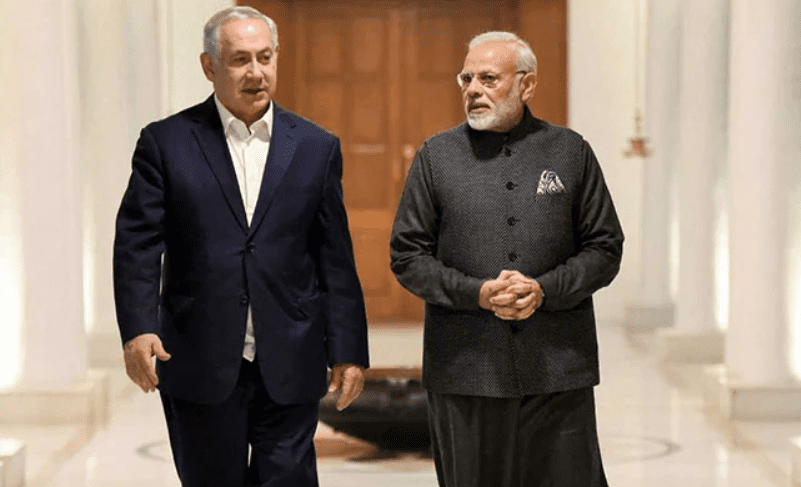
Netanyahu’s depiction of Indian Prime Minister Narendra Modi is the warmest extended portrait in the book, framed not merely as a diplomatic relationship but as a historical bond between two civilisational nationalists. He portrays the 2017 visit to the Zionist entity — the first by an Indian prime minister — in quasi-mythological terms, dwelling on the famous photograph of the two men walking barefoot along Olga Beach as a symbol of something deeper than protocol: a shared understanding between leaders of ancient peoples who have, in Netanyahu’s formulation, finally freed themselves from the patronising expectations of the post-colonial world order.
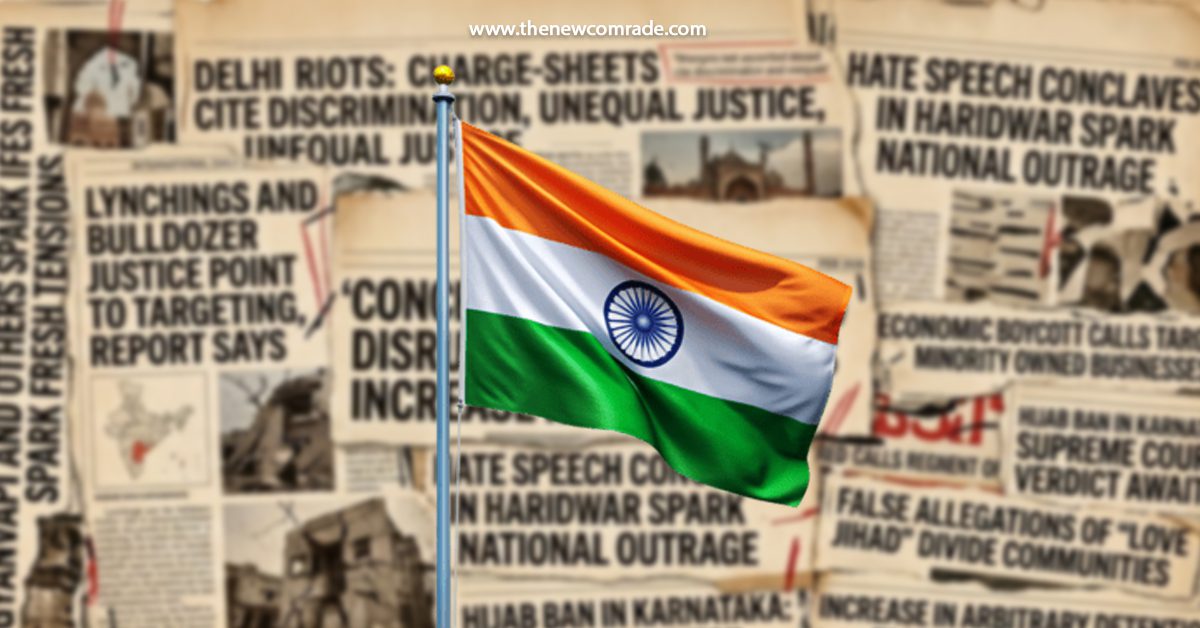
The centrepiece of this portrait is what Netanyahu calls the ‘de-hyphenation’ of Indian foreign policy. For decades, he argues, India’s relationship with the Zionist entity was limited by its membership of the Non-Aligned Movement and its cultivation of Arab states. Modi, in this telling, possessed the courage to place his interests — specifically the access to Zionist military technology, counter-terrorism intelligence, and agricultural innovation — above the ‘worn-out dogmas’ of his predecessors’ solidarity with the Palestinian cause. What this account carefully omits is the nature of the ideology that underpins Modi’s interests. For ‘RSS’, the Hindu nationalist fascist organisation from which Modi emerged, absolute xenophobia and bigotry against India’s Muslim community forms the raison d’être. Under Modi’s governance, India has had a sharp rise in attacks on Muslims, the introduction of citizenship legislation explicitly discriminatory on religious community grounds, stripping of constitutional autonomy from the Muslim-majority Kashmir Valley and much more of the same genre. Netanyahu’s admiration for Modi is predicated on shared ‘civilisational’ nationalism — a worldview in which Muslims are perpetually suspect and the nation is defined by the dominance of groups against them. The ‘soulmate’ quality that Netanyahu perceives in Modi is not incidental to this politics; it is its most precise expression.
Vladimir Putin: Cautious Clinical Respect
If the Modi portrait is warm, the depiction of Vladimir Putin is, by Netanyahu’s own admission, one of ‘cautious, clinical respect.’ He approaches Putin as a fellow practitioner of Realpolitik, a man who, having no illusions about the world, commands a form of grudging professional admiration. He describes Putin as possessing ‘eyes like a wolf’ — rationally predictable because transparently self-interested, willing to operate within understood limits only as long as those limits serve his goals.
The core of their relationship, as Netanyahu presents it, was the ‘de-confliction’ arrangement in Syria. He recounts informing Putin directly, during meetings in the Kremlin, that his entity would continue to strike Iranian military assets on Syrian territory regardless of Russian preferences, and that he expected a degree of Russian acquiescence in exchange for his restraint in other domains. He portrays this blunt transactional communication as the only language Putin respects and presents himself as uniquely qualified to speak it — the only Western-aligned leader capable of ‘talking tachlis’ with the Russian president.
What Netanyahu’s approving portrait of Putin does not mention is the rather substantial matter of what Putin’s Russia actually represents: a kleptocratic authoritarian state responsible for the annexation of foreign territory, the systematic assassination of political opponents and journalists, the bombardment of civilian infrastructure in Syria and later Ukraine, and the deliberate destabilisation of democratic institutions across Europe and North America. Netanyahu’s defence of his frequent trips to Moscow — heavily criticised by his own domestic opposition — as a ‘necessary balancing act’ is a formulation that reveals much about the moral universe of Zionist strategic culture, in which the crimes of partners are simply not part of the calculation.
Angela Merkel: Philosophical Adversary
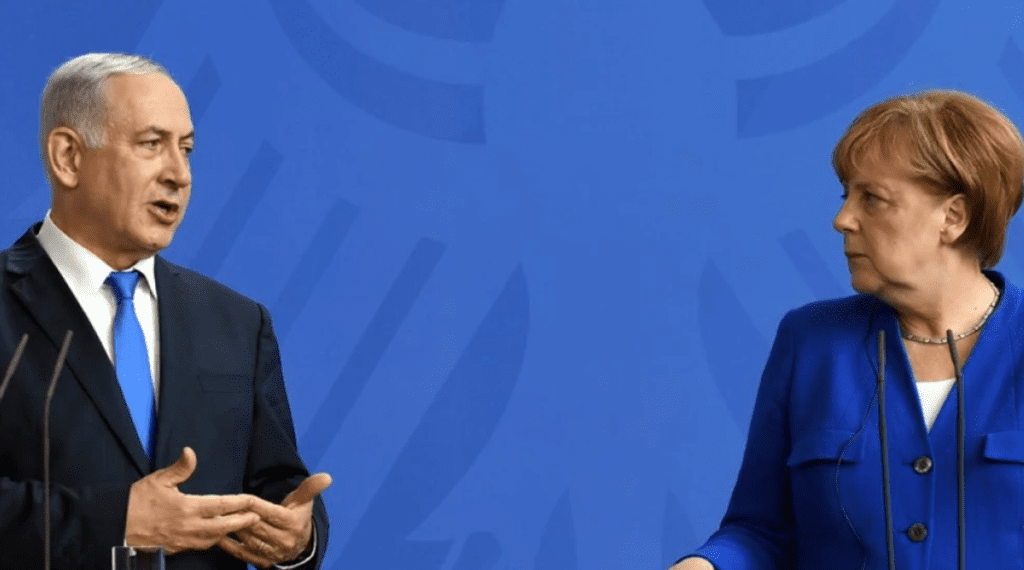
The portrait of former German Chancellor Angela Merkel is one of the memoir’s most intellectually honest, in the sense that Netanyahu clearly struggles to dismiss her. He respects her intellectual rigour and acknowledges Germany’s constitutional and historical commitment to Zionist security, whilst characterising their relationship as one of fundamental and persistent disagreement. Merkel, in his telling, was ‘captured by the bureaucracy of Brussels’ and committed to a multilateral framework that Netanyahu regarded as both naive and dangerous.
He recounts tense private meetings in which Merkel pressed him on settlement construction and the two-state solution and reveals his frustration at what he describes as her application of ‘European dreams to West Asian realities.’ The condescension in this formulation is considerable. Angela Merkel was one of the most consequential political leaders of the early twenty-first century, a scientist by training who navigated the Eurozone crisis, the refugee emergency, and the rise of populist nationalism. Netanyahu’s dismissal of her framework as naive is not a critique derived from superior knowledge of the region; it is an assertion that his own security-centred analysis is the only legitimate lens through which the West Asia can be viewed.
Their sharpest disagreement was over the Iran deal, where Merkel, along with France and Britain, maintained support for an agreement that represented the considered position of five permanent members of the United Nations Security Council plus the European Union. Netanyahu presents her support for the JCPOA as a failure of historical imagination, which is a striking charge to level.
Viktor Orban: Tactical Alliance
Netanyahu is notable for his unapologetic account of his relationship with Hungarian Prime Minister Viktor Orban, a figure who has done more than perhaps any other European leader to erode the institutional checks on executive power, to intimidate the judiciary and the free press, and to legitimise anti-Semitic tropes in the political mainstream — this last being a particularly striking irony given the context. Netanyahu’s justification is baldly transactional: Orban delivered votes. By cultivating the Visegrad Group of Central European states, Netanyahu ensured that EU resolutions critical of Israeli policy could not achieve unanimity, as required under the EU’s foreign policy decision-making rules.
He evaluates Orban not as a moral exemplar but as a ‘reliable partner.’ Critics who pointed out that Orban’s political campaigns had relied on anti-Semitic imagery — most notoriously a 2017 campaign that depicted George Soros, a Hungarian-born Jewish philanthropist, as a malevolent puppet-master threatening ‘Christian Hungary’ — are dismissed as raising ‘internal European affairs.’ The fact that the leader of the ‘Jewish’ state was publicly embracing a politician who deployed anti-Semitic imagery for domestic political gain was not lost on the Jewish diaspora communities of Europe or the United States. Netanyahu’s indifference to their concerns in favour of diplomatic utility is among the more morally uncomfortable moments in a book that presents itself as an account of Jewish survival.
Emmanuel Macron: Intellectual Distance
The portrait of French President Emmanuel Macron is professionally cordial but intellectually dismissive. Netanyahu characterises him as ‘brilliant but misguided,’ a leader who tries to ‘bridge too many gaps at once’ and speaks, as a result, with two voices: one supporting Israel’s security and another catering to the traditional pro-Arab orientation of the French Foreign Ministry statements. The critique is that Macron values ‘grand gestures’ over ‘hard-nosed results.’
The specific episode Netanyahu dwells upon is Macron’s attempt at the 2019 G7 summit in Biarritz to arrange a meeting between Donald Trump and Iranian Foreign Minister Javad Zarif, with the aim of opening a diplomatic channel. Netanyahu describes his ‘frantic’ efforts to block this initiative, which he viewed as a dangerous legitimisation of the Iranian regime. What he presents as principled opposition was, in reality, an intervention by the leader of a foreign country in the diplomatic strategy of the US — behaviour that, in any other context, Netanyahu would categorise as an unacceptable violation of sovereignty.
Mohammed bin Zayed
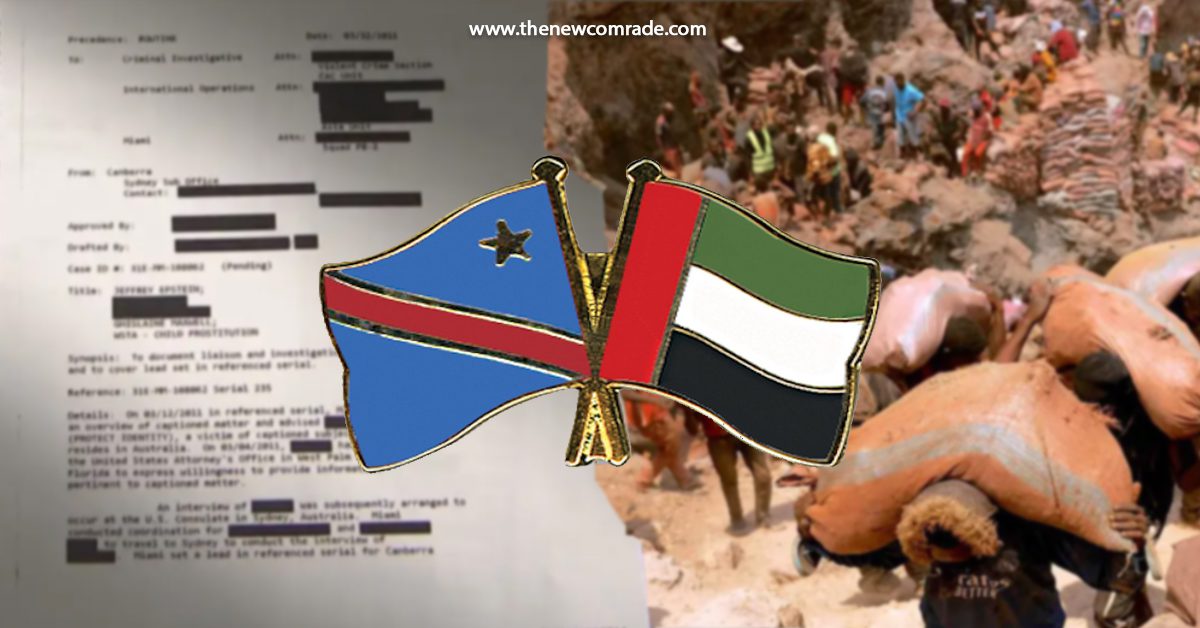
Netanyahu’s portrait of Sheikh Mohammed bin Zayed Al Nahyan (MbZ), the President of the United Arab Emirates, is the most reverential in the entire book. He evaluates Al Nahyan not merely as a pragmatic head of state but as a ‘visionary strategist’ who, like Netanyahu himself, possessed the historical imagination to lead his nation out of the ideological constraints of the twentieth century. Their relationship, as Netanyahu presents it, stretches back nearly a decade before the 2020 signing of the Abraham Accords, grounded in a shared assessment of the Iranian threat.
He recounts a pivotal 2012 meeting in New York at which the two men examined a map of the West Asia together, with Netanyahu tracing the ‘creeping tiger’ of Iranian influence across Iraq, Syria, Lebanon, and Yemen. The revelation — emphasised because Netanyahu considers it central to understanding the Accords — is that Al Nahyan possessed ‘instant strategic clarity’: he saw, without prompting, that the Arab-Zionist conflict was a luxury that the Sunni states could no longer afford in the face of the Iranian challenge. This portrait serves Netanyahu’s broader thesis impeccably: that the Palestinian cause was always an instrumentalisation of Arab politics rather than a genuine moral commitment, and that once the strategic circumstances shifted, it could be set aside without great difficulty.
The critique of this portrait must engage with what the Abraham Accords actually represented for Palestinians. The normalisation agreements were reached without any concessions on Israeli settlement construction, without any commitment to Palestinian statehood, and without any mechanism for addressing the ongoing military occupation of the West Bank or the siege of Gaza. For the Palestinian people, the Accords represented the formalisation of their abandonment by the Arab states whose solidarity had long been one of their most important diplomatic assets. That Netanyahu presents this as a triumph for ‘peace’ — and portrays Al Nahyan as a visionary for facilitating it — tells us much about the values that animate his diplomacy.
Mohammed bin Salman: The Silent Enabler
Netanyahu’s treatment of Saudi Crown Prince Mohammed bin Salman is more circumspect than his account of Al Nahyan, partly for reasons of diplomatic sensitivity and partly because the full normalisation between Israel and Saudi Arabia remained unachieved at the time of writing. He credits MbS with providing the ‘explicit approval and encouragement’, without which the UAE and Bahrain deals could not have proceeded, and evaluates him as a ‘transformative force’ dragging the Kingdom into the twenty-first century through his ‘Vision 2030’.
The admiration Netanyahu expresses for MbS — for his willingness to ‘take immense risks to modernise his society’ — must be read alongside the public record of MbS’s governance. In 2018, the journalist Jamal Khashoggi, a Saudi national and Washington Post columnist, was murdered and dismembered inside the Saudi consulate in Istanbul by a team of operatives linked directly to MbS, according to findings by both the CIA and a United Nations special rapporteur. MbS has overseen the imprisonment of many women’s rights activists, reputed scholars, massive bombardment of Yemen — producing one of the world’s worst humanitarian disasters — and the brutal suppression of political opposition. Netanyahu’s portrayal of such a leader as a ‘moderniser’ worthy of clinical admiration is not realism; it is the reflection of the supposedly moral vocabulary that Netanyahu otherwise deploys so freely when discussing his opponents.
King Abdullah II: Precarious Neighbour
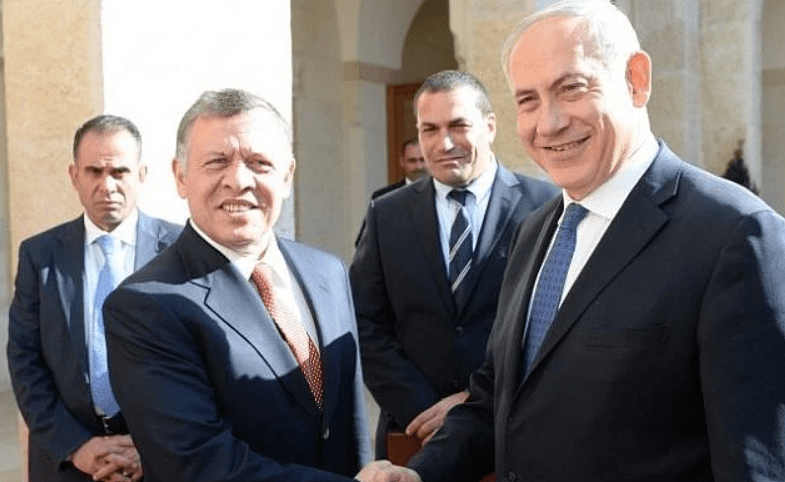
The portrait of Jordan’s King Abdullah II stands in sharp contrast to the warmth extended to the Gulf monarchs. Netanyahu depicts Abdullah as a leader caught in an ‘impossible bind,’ required by Jordan’s demographics and political culture to maintain a publicly hostile posture towards the Zionist entity whilst cooperating closely with Zionist intelligence and security forces behind closed doors. He characterises this as a lack of ‘strategic boldness,’ contrasting Abdullah unfavourably with his father, the late King Hussein.
The critique embedded in this portrait is less persuasive than Netanyahu seems to appreciate. Abdullah II rules a country in which more than half the population is of Palestinian origin. His need to maintain distance from Zionist policy is not a matter of intellectual timidity; it is a recognition of the legitimate political concerns of his own people, many of whom have direct family connections to communities living under Zionist occupation or in refugee camps. That Netanyahu interprets Abdullah’s sensitivity to Palestinian suffering as ‘looking over his shoulder’ at the ‘Arab street’ is revealing – it reduces the agency and moral seriousness of millions of people vis-à-vis his own needs to the status of a domestic inconvenience that a sufficiently bold leader ought to override.
Mahmoud Abbas and the Palestinian Veto
Netanyahu’s treatment of Palestinian Authority President Mahmoud Abbas is unremittingly hostile, framed through a set of rhetorical devices designed to pre-empt any possibility of genuine engagement. He describes showing Donald Trump a video of Abbas ‘talking about peace in English and praising terrorists in Arabic,’ and evaluates Abbas as an ‘obstacle to peace’ who has clung to the diplomatic leverage granted him by international recognition of Palestinian rights.
The crucial ‘revelation’ of the Abraham Accords chapters, in Netanyahu’s own framing, is his triumph in ‘marginalising’ Abbas — in demonstrating that Arab states could normalise relations with Zionist entity without Palestinian agreement, effectively removing the so-calleds ‘veto’ that the Palestinian leadership had historically possessed over the pace and terms of Arab-Zionist engagements. Netanyahu presents this as a liberation: the freeing of Arab ‘pragmatism’ from Palestinian ‘maximalism’. What it actually represents — the consignment of millions of stateless people to permanent irrelevance in the diplomatic processes that determine their fate — is a dimension that his memoir treats as simply uninteresting.
The comparison he draws between Abbas and the late Yasser Arafat, both of whom he portrays as ‘anti-Sadats’ incapable of acknowledging Zionist permanence, is a rhetorical gambit that papers over the asymmetry of power that has defined the conflict throughout Netanyahu’s career. Palestinian leaders have been asked, at every negotiating table, to accept the terms of an occupation rather than negotiate its end. Their reluctance to do so is not, as Netanyahu insists, evidence of a constitutive commitment to Zionist entity’s destruction; it is a response to the observable reality that each round of negotiations has been accompanied by an acceleration of settlement construction, a deepening of the occupation, and a narrowing of the space within which a viable Palestinian state could ever be established.
Yitzhak Rabin: Reverence and Ideological Conflict
Netanyahu’s treatment of Yitzhak Rabin is the most emotionally conflicted passage in the book, and it requires careful reading. He expresses genuine, almost fraternal respect for Rabin’s military record and his physical courage, portraying him as a ‘soldier-statesman’ of the old school who felt the weight of the fallen on his shoulders. This reverence is, however, systematically qualified by Netanyahu’s assessment of Rabin’s political judgement in the Oslo period.
He evaluates Rabin as a leader who was ‘misled’ by the ‘mirage of peace’ peddled by Shimon Peres and the Israeli Left, and portrays him as increasingly aware, in his final months, of the ‘security traps’ being laid by Yasser Arafat but politically unable to reverse course. This portrayal serves a precise narrative function: it separates Rabin ‘the warrior’ from Rabin ‘the peacemaker’, lionising the former whilst effectively discrediting the latter. It is a form of posthumous appropriation — claiming Rabin’s military legacy for the Right whilst treating his most significant political act as a catastrophic error. The fact that Netanyahu’s own political career was substantially built upon the campaign of delegitimisation against Rabin that preceded his assassination in 1995 makes his intentions clearer.
Ariel Sharon: Mentor Turned Apostate
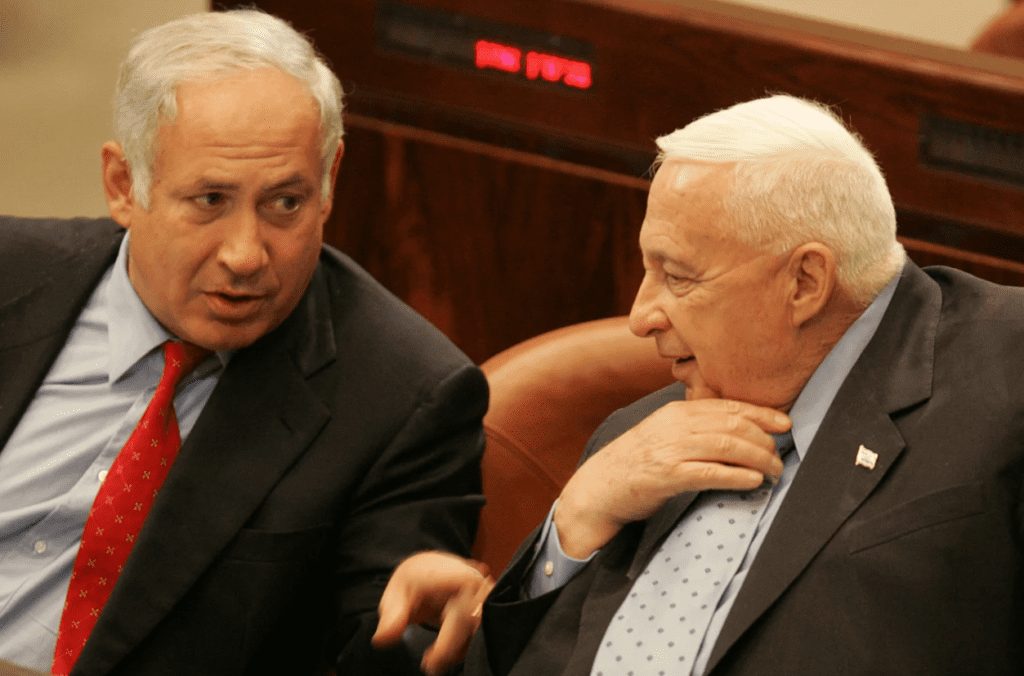
The relationship with Ariel Sharon — the ‘Bulldozer’ of Israeli politics — is depicted as a complex blend of mentorship, shared military culture, and ultimate strategic betrayal. Netanyahu admires Sharon’s decisiveness during the Second Intifada, his willingness to ‘act first and explain later.’ But the narrative pivots sharply at the 2005 Gaza Disengagement, which Netanyahu evaluates as a ‘capitulation to international pressure’ and a failure of strategic foresight.
He portrays himself as the ‘prophet in the wilderness’ of the Sharon years, resigning from the government as a principled stand against withdrawal and warning, in private, that Gaza would become ‘Hamastan.’ The self-presentation requires scrutiny. Netanyahu’s opposition to disengagement was rooted in a conviction that Zionist control of territory was non-negotiable, regardless of its costs to those living under that control. The subsequent history of Gaza — the blockade, the repeated military operations, the humanitarian catastrophe — clears air about Netanyahu’s ‘prophecy’.
Ehud Barak: Intellectual Rival
Netanyahu’s treatment of Ehud Barak — Zionist entity’s most decorated soldier and, in an earlier phase of their relationship, his commanding officer — is the most pointed and personally revealing portrait in the domestic section. He approaches Barak as a primary intellectual rival, a man of exceptional talent whom he is nonetheless determined to diminish.
The most striking ‘revelation’ in this passage concerns the 1972 Sabena hijacking operation. Netanyahu describes Barak, who commanded the response, as essentially a ‘bystander’ — present on the tarmac but not among those who stormed the aircraft — and suggests that several of Barak’s military decorations were awarded for intelligence work rather than battlefield leadership. The anecdote is designed to strip away the mythology of Barak’s martial prestige, portraying him as someone who absorbed the credit for the bravery of others, implicitly including Netanyahu himself. The use of a specific page reference within the memoir signals that Netanyahu is well aware this claim is contentious and is pre-emptively documenting his case.
On the political level, Netanyahu evaluates Barak’s leadership of the 2000 Camp David summit as ‘reckless,’ and treats it as a case study in the dangers of ‘intellectual brilliance’ untempered by ‘strategic realism.’ This characterisation suppresses the more complex history of Camp David: the evidence that Arafat was offered less than is often claimed, that the ‘generous offer’ was considerably less comprehensive on issues such as Jerusalem and the right of return than Zionist mythology has insisted, and that the breakdown of negotiations reflected structural failures on both sides rather than Palestinian rejectionism alone.
Naftali Bennett: Opportunist Betrayal
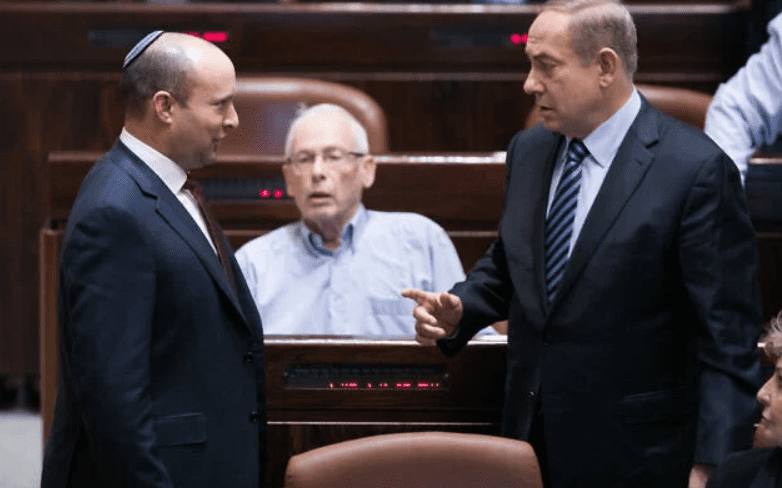
Toward the book’s conclusion, Netanyahu turns to the leaders of the 2021 ‘Government of Change’ that succeeded him, evaluating Naftali Bennett — his former aide and political protégé —as an ‘opportunist’ who betrayed the right-wing bloc for the sake of personal ambition. The sense of personal grievance in this section is palpable, and it points toward something important about Netanyahu’s political identity: he cannot conceive of opposition to his leadership as principled. Anyone who challenges him is, by definition, either naive, corrupt, or working for the Left. The possibility that a serious politician might examine Netanyahu’s record and conclude that he has become a liability to the causes he claims to champion is not entertained.
The portrayal of the Bennett-Lapid government as an ‘unnatural alliance’ that endangered Zionist security by including the United Arab List in a governing coalition is particularly revealing. Netanyahu is perfectly comfortable, as the memoir demonstrates at length, with strategic alliances with authoritarian regimes across the world. His objection to the inclusion in governance of Arabs and Muslims, even as citizens of the Zionist entity, reveals where, in his hierarchy of values, ‘liberal democracy’ actually sits.
‘Bibi Doctrine’ as a World-View: A Legacy of Blood and Arson
Taken together, Netanyahu’s portraits of world leaders constitute a remarkably coherent and remarkably troubling political philosophy. Its central axiom is that strength is the only currency of international life, that the ‘jungle’ of the West Asia rewards power and punishes concession, and that those who fail to understand this are not merely mistaken but dangerous. In Netanyahu’s worldview, there are no citizens, only combatants; no neighbours, only targets. The corollary is that Netanyahu himself, uniquely possessed of historical perspective and strategic clarity, is indispensable to the survival of the Zionist state—a self-anointed messiah of security who has, in reality, become the primary architect of its current moral and regional positioning.
The evaluative hierarchy that emerges across this analysis is consistent and chilling. Leaders who acknowledge Zionist power and align themselves with Netanyahu’s security framework — Reagan, Bush Jr, Modi, MbZ, MbS, Orban — receive admiring portraits. These are the partners in his “Realpolitik,” men who speak the language of force. Conversely, leaders who insist on the independent validity of Palestinian rights, the importance of multilateral institutions, or the capacity of diplomacy to constrain state violence — Obama, Merkel, Macron, Rabin — are portrayed as, at best, tragic idealists and, at worst, dangerous fools. It is a pathological rejection of the very concept of a rules-based order, replaced by a nihilistic worship of the “Iron Wall.”
What the memoir does not — and cannot — accommodate is the devastating weight of the evidence against its own premises. Zionist entity under Netanyahu’s leadership has seen the two-state solution effectively extinguished and the settlement enterprise expanded into a permanent architecture of dispossession. The ultimate indictment of the Bibi Doctrine is found in the ruins of Gaza. Under his command, the “open-air prison” has been transformed into a systematic killing field. His refusal to acknowledge Palestinian humanity has culminated in a campaign of indiscriminate slaughter, where the decimation of entire generations and the weaponisation of famine are presented as strategic successes. To Netanyahu, the thousands of children buried under the rubble of Gaza are not a moral catastrophe, but merely something to be explained as a “collateral” damage to those who invoke standards he abhor.
This blood-soaked “realism” extends beyond the borders of Palestine to a reckless, pyromaniac engagement with the whole region. By repeatedly attacking Iranian interests and pushing the region toward the precipice of a total war, Netanyahu reveals his true endgame: a state of perpetual conflict that ensures his own political survival. He treats regional stability as a disposable commodity, gambling with the lives of millions to maintain a posture of belligerent defiance. His latest obsession with Iran is not merely a security concern; it is a calculated diversion, a way to externalise the consequences of his own failed domestic and colonial policies through high-stakes military adventurism.
Netanyahu portrays himself, in the memoir’s final pages, as the ‘Defender of Jerusalem’ — a figure of Churchillian stubbornness who, alone among his contemporaries, has the moral courage to speak hard truths to a complacent world. The reader will recognise this construction for the grotesque vanity it is. The world as Netanyahu sees it is a mirror in which only his own reflection appears coherent. Everyone else is either a student who has not yet grasped the lesson, a rival whose achievements must be diminished, or an adversary whose humanity can be safely, and violently, disregarded.
Rather than political realism, this is the sociopathic logic of a political leader who has mistaken the persistence of conflict for its inevitability, and the endurance of his own power for evidence of his indispensability. The personalities in “Bibi: My Story” are, ultimately, less interesting as studies of those individuals than as a portrait of a narrator whose life’s work has been dedicated to ensuring that the door to ‘peace’ remains permanently bolted. Netanyahu’s legacy will not be one of security, but of a graveyard: a region set on fire, a façade of moral fabric shredded, and a trail of blood that stretches from the levelled neighbourhoods of Gaza to the brink of a catastrophic regional war.
Disclaimer: The opinions expressed in this article are solely the author’s and do not neccessarily reflect the opinions or beliefs of the website and its affiliates.