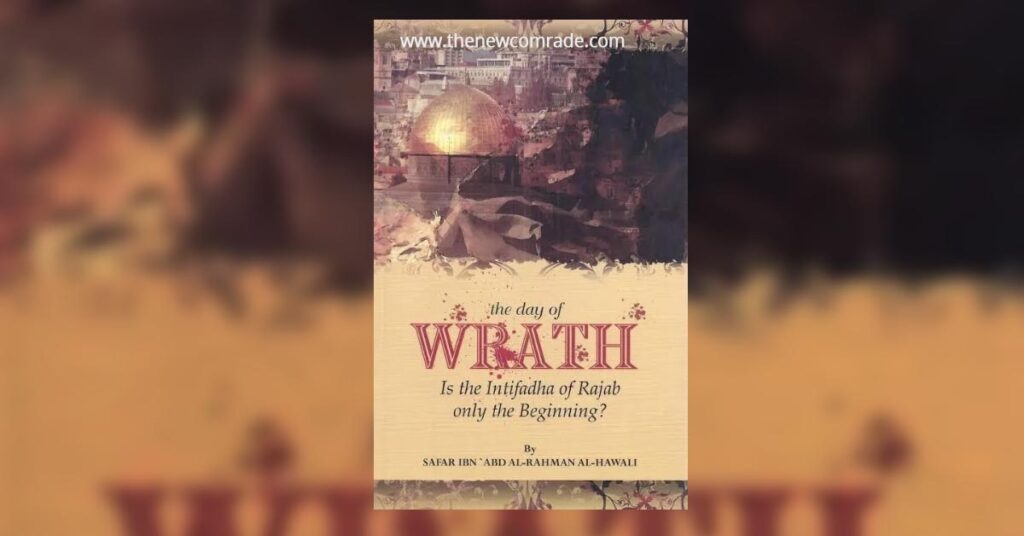
In the turbulent landscape of contemporary politics in Muslim world, few texts present as audacious and theologically peculiar a synthesis as “The Day of Wrath: Is the Intifadha of Rajab Only the Beginning?” by Safar ibn ‘Abd al-Rahman al-Hawali. First published in Arabic in 2000 and subsequently disseminated in English translation in 2002, the treatise emerged directly from the psychological and political desolation that followed the collapse of the Oslo Accords and the eruption of the Second Intifada — ignited, as al-Hawali recounts, by Ariel Sharon’s “inauspicious visit” to the sacred Aqsa Mosque compound in September 2000. The book quickly achieved wide circulation, attracting readers well beyond the Arab world and generating significant attention.
Al-Hawali occupies a distinctive position within the intellectual genealogy of contemporary Muslim religious activity and scholarship. Born in Saudi Arabia in 1950, he rose to prominence with the religious renaissance of the 1980s. He earned his doctorate in theology from Umm al-Qura University in Makkah Mukarramah, with his dissertation focusing on secularism. This sustained preoccupation with the encroachment of Western modernity upon the Muslim Ummah shaped much of his subsequent scholarship. His earlier, equally famous treatise, “Wakefulness: The Palestinian–Israeli Conflict from an Islamic Perspective”, had already established him as a voice of confrontational intellectual resistance. It was his public opposition to the stationing of American troops on Arabian soil during the Gulf War of 1991 that brought him to international attention, and his subsequent imprisonment from 1994 to 1999 only deepened his oppositional credentials.
The Day of Wrath, however, represents a significant departure from conventional traditionalist intellectual methodology. Rather than confining himself to the Qur’an and the Hadith as the sole evidentiary sources for his political claims, al-Hawali turns his gaze upon the very scriptures of his adversaries—the Torah and the Christian Bible—and argues that these texts, read honestly and stripped of rabbinical and priestly manipulation, actually prophesy the destruction of the Zionist entity and the vindication of the Muslim world. It is, in essence, an exercise in theological counter-intelligence: using the enemy’s sacred texts as a weapon against the enemy itself.
The stated purpose of the work is carefully framed. Al-Hawali insists that the book was “not written to give them glad tidings, the Qur’an and the Sunnah are sufficient for that purpose. Any other source has limits to its reliability and therefore cannot be the basis of Muslim belief” (p. 3). Rather, he explains, the work aims to “outline terms for engagement with the theoretical foundations of Zionism in its two facets: Jewish Zionism and Christian Zionism, the enemy, which has distracted the world, and filled the airwaves as well as books with talk of Biblical Prophecy” (p. 3). From the outset, therefore, al-Hawali positions himself as a polemicist entering the enemy’s own theological arena, armed with the enemy’s own textual inheritance.
This review will trace the major arguments of “The Day of Wrath” across its principal thematic divisions: the political context of the Second Intifada, the Islamic epistemology of prophecy, the devastating critique of Christian Zionism, the elaborate re-reading of the Book of Daniel and related biblical prophecies, the characterisation of the Jewish people and the Zionist project, the identification of the United States as the modern Babylon, and the apocalyptic conclusion regarding the approaching Day of Wrath. Throughout, the review will situate al-Hawali’s arguments within the broader context of Islamic political thought and comparative eschatology, attempting to identify both its intellectual audacity and its methodological and ethical contentions.
The Political Context: Intifada, Diplomacy, and the Illusion of Peace
The opening section of “The Day of Wrath”, titled “The Intifadha of Rajab,” is less a theological argument than a political chronicling. Al-Hawali surveys the wreckage of the Oslo peace process with barely concealed fury, describing years of negotiations as a “winding labyrinth of fruitless negotiations and content-less meetings” (p. 5). He portrays the Palestinian people as having been left utterly vulnerable by the diplomatic frameworks of the international community, “like a lamb among wolves” (p. 5), while Zionist leaders of every political stripe systematically consolidated territorial gains.
Central to al-Hawali’s analysis is an absolute rejection of the distinction between Zionist political factions. For him, the binary of hawks and doves is a deliberate fiction engineered to manufacture the appearance of internal debate while pursuing a unified expansionist agenda. He writes with rhetorical force: “In Jewish logic those whom they call hawks and those whom they call doves, compete against each other in zealotry, excess, crookedness, and delay. They oppose each other, yet they are both the same. They are not two sides of the same coin; either party can be either side. Thus, Jews are Jews” (p. 6). This essentialist formulation, in which the Jewish Zionist political opinion is considered a single, immutable collective identity, is one of the most basic leitmotifs of the entire text, recurring throughout subsequent chapters.
The specific trigger for the Intifada, as al-Hawali mentions it, was a Zionist proposal to divide the sacred Aqsa Mosque compound to administrative layers, in which the Zionist entity would retain sovereignty over the airspace and everything beneath the surface, leaving the Palestinian Authority with mere nominal caretaker status over the surface itself. This proposal, combined with Sharon’s visit, crystallised the absolute impossibility of a negotiated settlement. The Intifada, he argues, was not a failure of politics but a revelation of truth: “a cyclone that knocked down many barriers and walls, and blowing the cover off many plans and plots” (p. 4). The asymmetry of the conflict—”slingshots of David manufactured by shackled hands, standing before rockets of Goliath” (p. 5)—is consciously inverted, through the lines, as a spiritual metaphor, transforming Palestinian material weakness into a sign of impending divine justice.
The Islamic Epistemology of Prophecy
Before engaging with biblical texts, al-Hawali devotes considerable attention to establishing an Islamic framework for understanding prophetic knowledge. He acknowledges, with theological scrupulousness unusual for a polemical tract, that “the future is known only to Allah” and that prophetic visions must be approached with caution. He distinguishes three categories of biblical material: first, texts that are definitively false, in that they contradict what the Qur’an and authentic Sunnah have established; second, texts that are definitively correct, in that they are confirmed by Islamic revelations or by historical events; and third, neutral texts, which Muslims neither affirm nor deny because they cannot be verified against primary Islamic sources.
This tripartite classification draws upon the classical Islamic discourse on Isra’iliyyat — narratives derived from Jewish and Christian sources that circulated within early Islamic tradition. Al-Hawali’s deployment of this framework allows him to selectively engage with biblical texts, accepting those that align with his argument, while dismissing those that do not under the rubric of tahrif (textual corruption or distortion). He does not dispute the Islamic doctrine that the scriptures of the People of the Book have been corrupted; rather, he argues that sufficient authentic prophetic material remains embedded within the biblical text to serve as evidence against the very communities that preserve it. He invokes the Qur’anic challenge — “Say, bring forth the Torah and read it if you are truthful” (Qur’an 3:93) — transforming the act of biblical reading into an Islamic imperative.
Al-Hawali is equally emphatic that his engagement with biblical prophecy should not be misconstrued as an exercise in interfaith understanding or theological ecumenism. He explicitly states that the purpose of studying the enemy’s foundational texts is “the topical study of the doctrinal foundations of the enemy’s psyche and behaviour from their own sources which are the spiritual foundation of their faith in their cause” (p.2). The Bible, as such, is not any ‘bridge between religious communities’, as often projected, but an intelligence asset to be exploited in warfare.
The Critique of Christian Zionism
Perhaps the most intellectually sustained section of “The Day of Wrath” is its extended analysis of Christian Zionism — a movement al-Hawali regards as, in his own words, “the most dangerous to humanity of all contemporary movements” (p. 9). His familiarity with the internal theological architecture of American evangelical dispensationalism is, by any measure, impressive. He, correctly, identifies that the enthusiastic American Christian support for the Zionist entity is rooted not primarily in geopolitical calculation or ethnic solidarity, but in a specific theological framework — dispensationalism — that interprets the return of the Jews to the Holy Land as a divinely ordained precondition for the Second Coming of Christ and the battle of Armageddon.
Al-Hawali traces this current with particular precision in his discussion of what he calls the “mad fundamentalist current” in America — a movement he regards as entirely irrational and potentially apocalyptically dangerous. He catalogues, with evident alarm, the beliefs of this constituency: the establishment of the Zionist entity as a prophetic indicator of imminent divine intervention; the conviction that the peace process represents a delay of God’s promises; the insistence that all of Jerusalem must remain under exclusive Zionist sovereignty; the belief that the Zionist entity is uniquely blessed and that opposition to it constitutes opposition to God; and the anticipation of a Millennial reign preceded by a violent cataclysm at Armageddon. He writes: “America, as Edward Said says, is more occupied with religion than any other nation, and in America there is a totally mad fundamentalist current that seeks to hasten the second-coming of Christ, and who are prepared to do the stupidest thing in the world in order to achieve it. What could be stupider than attempting to infiltrate nuclear bases and dispatch nuclear devastation on the entire world?” (p.17).
Al-Hawali’s critique here is intellectually sharp in certain respects. He correctly diagnoses the way in which dispensationalist theology has operated as a force multiplier for Zionist entity’s territorial expansion by providing a theological narrative that transforms political choices into sacred obligations. He is also astute in recognising that this movement is not politically marginal but exercises “remarkable influence on society, as well as an effective media arsenal, and high-level government positions” (p.17). His fundamental objection is that Christian Zionists have betrayed the teachings of Jesus by subordinating them to a nationalistic, ethno-territorial eschatology, thereby transforming a message of universal redemption into a charter for geopolitical domination. He argues that a fair reading of the Hebrew prophets — one freed from the interpretive glosses of rabbinical and dispensationalist commentators — would reveal not a divine mandate for modern Zionist statehood but a prophetic testimony against it.
The Book of Daniel and the Architecture of Apocalypse
The intellectual centrepiece of “The Day of Wrath” is al-Hawali’s elaborate reinterpretation of the Book of Daniel, which he regards as one of the most theologically lucid books in the biblical corpus — unusual praise from an Islamic religious scholar who, in many other contexts, emphasises biblical corruption. He provides extended readings of Nebuchadnezzar’s vision of the idol in Daniel 2 and Daniel’s own vision of the four beasts in Daniel 7, as well as the complex prophetic chronologies of Daniel 8 through 12.
Al-Hawali’s key methodological device is the application of the “day-for-a-year” principle, a mode of prophetic interpretation well established within the Western historicist tradition of biblical commentary — used, most famously, by the Millerites and early Seventh-day Adventists to calculate prophetic timelines. Through this method, prophetic periods expressed in days are converted into years of actual historical time. Al-Hawali identifies 688 CE — the year in which construction of the Dome of the Rock on the sacred Aqsa mosque compound was commenced under the Umayyad Caliph ‘Abd al-Malik ibn Marwan — as his primary historical anchor. By adding the 1,290-day/year period specified in Daniel 12:11 to 688 CE, he arrives at 1978 CE, which he identifies with the Camp David Accords — an event he characterises as the formalisation of Islamic capitulation and the consolidation of the Zionist abomination over the holy sanctuaries. Adding the 1,335-day/year figure from Daniel 12:12 to the same starting point yields approximately 2023–2024 CE, which he identifies as the approaching Day of Wrath!
At another instance in his calculation, al-Hawali takes with another starting point. He writes: “When Daniel specified the period between its distress and relief… he put it as forty-five years! We have already seen that he specified the time of the establishment of the abomination of desolation as the year 1967… Therefore, the end — or the beginning of the end — will be 1967 + 45 = 2012” (p. 91).
These calculations — yielding dates of 2012 and 2023 ~ 2024 at various points in the text — reflects the fundamental arbitrariness of the entire enterprise: the starting dates, the calendar conversions (between Gregorian and Hijri reckoning), and the identification of historical events with prophetic markers.
The identification of the “Abomination of Desolation” is central to al-Hawali’s entire argument. In conventional Christian and Jewish historiography, this phrase, drawn from Daniel 9:27, 11:31, and 12:11, is typically applied either to the desecration of the Second Temple by Antiochus IV Epiphanes in the second century BCE or to the destruction of Jerusalem by the Roman legions of Titus in 70 CE. Christian dispensationalists, by contrast, project it into the future as a reference to a coming Antichrist. Al-Hawali systematically rejects all of these readings and instead identifies the Abomination with the establishment of Zionist sovereignty over Jerusalem and the sacred Aqsa Mosque compound, writing: “The ‘abomination of desolation’ is the establishment of the Zionist entity in the Holy Land, an event that violates the sanctity of the land and the rights of its people, and which is the precursor to the final wrath” (p. 24). By framing the existence of the Zionist entity as an ontological theological abomination rather than a political entity, al-Hawali removes it from the realm of diplomacy and relocates it within the fixed order of divine eschatology.
Equally striking is al-Hawali’s reinterpretation of the sacred geography embedded in Daniel’s prophecies. He argues at length that the “New Jerusalem” and the “House of God” described in biblical prophetic literature do not refer to the Jerusalem of the sacred Bayt al Maqdes but to Makkah Mukarramah. He identifies the “cube-shaped structure” located in the “wilderness of Paran” (the traditional homeland of Ishmael in Islamic traditions) with the Ka’bah; the “valuable stone” with the Black Stone; the “health-giving water” with the Zamzam well; and the worshippers who “shave the hair of their heads” and wear garments “from their loins to their legs” with pilgrims performing the Hajj in the state of ihram. He concludes that the “Holy People” or “Saints of the Most High” described in Daniel as the inheritors of the everlasting kingdom are the Muslim Ummah, “the only nation that worships Allah shoulder to shoulder” (p. 47). The “Fifth Kingdom” that crushes all previous pagan empires — the stone “cut without hands” from Daniel 2 — is, in his reading, Islamic Caliphate.
The Characterisation of Jews and the Jewish Psyche
In a chapter titled “Jews Are Jews” he assembles a lengthy catena of biblical condemnations drawn from Deuteronomy, the Psalms, Isaiah, Jeremiah, and Ezekiel, presenting them as an unbroken testimony to Jewry’s moral depravity across historical epochs.
The most extended and revealing such passage reads as follows: “Jews are Jews since the worshippers of the golden calf who desired a god like the gods of the pagans, breakers of the covenant of Allah at every opportunity, those who said, ‘We will not believe in you until we see Allah clearly,’ those who said, ‘Go, you and your Lord and fight, we will be sitting right here,’ those who distorted words [of scripture] from their proper places, devourers of ill-got gain and usury, those who said that Allah’s hand is bound, that Allah is poor and we are rich, slayers of the prophets, concealers of the truth, who forsook commanding right and forbidding wrong, who were cursed on the lips of David and Jesus son of Mary, those who were transformed into apes and pigs… From those of ancient times to these of modern times, they have not changed their nature. They have not refined their behaviour, and their punishment will be no different” (p.27).
Al-Hawali insists, at various points, that his condemnation is directed at the Zionist project rather than at the Jewish people as an ethnic community, and that he harbours no hostility toward Jews who genuinely embrace the teachings of their Torah without the distortions of rabbinic interpretation. He even extends what he presents as a sincere humanitarian invitation: “I advise them to read it, but with their intelligence and awareness, not with the Rabbis’ glosses and interpretations, and they would discover the truth, which would soon be clearly seen by the whole world” (p.5). He expresses the hope that individual Jews might “enter Islam— which is the Faith of Abraham — and to share with us in the blessing of faith in all of Allah’s scriptures and messengers” (p.5).
Yet a rhetorical slippage between theological critique and ethnic essentialism appears often. The collapsing of the ancient Israelites of the Hebrew Bible, the medieval and early modern Jewish communities, and the contemporary Zionist entity to a single, undifferentiated entity defined by a permanent, inherited “psyche” of rebellion, deception, and covenant-breaking is not merely historically inaccurate; it is the structural logic of anti-semitic discourse, regardless of the theological framing in which it is embedded. In such a respect, al-Hawali writes that the Bible “is the most anti-Semitic book on earth” because it repeatedly characterises the children of Israel as a “rebellious house,” “stiff-necked,” and “polluted with harlotry”.
The United States as Modern Babylon
Al-Hawali reserves a significant portion of “The Day of Wrath” for an extended identification of the United States as the modern incarnation of the biblical Babylon — the great imperial power, whose wealth, military dominance, and spiritual decadence have made it the primary enabler of the Zionist project. He draws on the imagery of the Book of Revelation, particularly the figure of the “Great Whore” and the city of Babylon described in Revelation 17 and 18, to construct a theological portrait of American civilisation.
He writes: “The relationship between the United States and the Zionist entity is not one of mutual benefit, but one of a spiritual sickness, where the former serves the latter to its own eventual ruin” (p. 62). America, in this reading, has been bewitched by Zionism into supporting a political enterprise that is divinely condemned. By acting as Zionists’ protector and patron, the United States has made itself complicit in the “abomination” and has thereby invited upon itself the same divine wrath that will destroy the Zionist entity.
Al-Hawali interprets the three serpents of Isaiah 27:1 as a coded reference to three specific political entities: Britain (the fleeing, or “bar,” serpent), Zionist entity (the twisted, or “crooked,” serpent), and America (the dragon, or “great reptile of the sea”). He also draws on the imagery of the “merchants of the earth” in Revelation 18 to portray America as a nation of luxurious consumption and global commercial empire that has “made the earth drunk with the wine of her fornication.” The prophetic verdict, in his reading, is unambiguous: America will be devastated by “winds, storms, and earthquakes” and overrun by enemies who will “lift a shout against her.”!
This identification of the United States as a prophetically condemned imperial power was particularly potent in the context of the book’s composition and initial circulation. Written before the September 2001 attacks and circulated widely thereafter, the text’s portrayal of America as a decadent and spiritually corrupted empire whose destruction is foretold in its own sacred scriptures provided a theological framework that many readers found resonant with the events of that September morning. While al-Hawali does not explicitly call for violence against American targets in this text, the theological infrastructure he constructs — in which America’s suffering is divinely preordained and historically inevitable — provides precisely the kind of eschatological rationalisation intended here.
“The Day of Wrath”: Eschatological Culmination
The culminating vision of “The Day of Wrath” is the author’s description of the divine judgment that will descend upon the Zionist entity, its Western patrons, and all those who have participated in or enabled the “abomination of desolation.” Al-Hawali draws extensively on the prophetic imagery of Isaiah, Jeremiah, Ezekiel, Zechariah, and the Minor Prophets to construct a portrait of a coming military catastrophe that will reduce the Zionist state to ruin.
He interprets the victorious army described in these prophetic texts — the “people from the north” and “the farthest parts of the earth” who will descend upon Israel with overwhelming force — as the Muslim armies of the future, instruments of divine wrath operating within the unfolding pattern of prophetic fulfilment. He cites Zechariah’s prophecy that the Jewish population in the land will be divided into three portions: one-third to “be cut off and die,” one-third to “be struck with the sword,” and one-third to “be scattered to the wind.” A faithful remnant, he anticipates, will survive only by submitting to divine will and entering Islam.
The chronological culmination of al-Hawali’s argument is the calculation noted earlier: adding forty-five years (the difference between Daniel’s 1,290 and 1,335-day figures) to the year of the establishment of the “abomination of desolation” — whether dated to 1948, 1967, or 688 CE — yields a specific window of years within which the Day of Wrath is expected to arrive. As al-Hawali writes: “Thus, the year 2012 will be the year of the beginning of the end of this entity, and the start of the ‘Day of Wrath’ which the prophets spoke of” (p. 91). He is careful, in various moments, to acknowledge that “we do not declare it to be absolutely certain”.
Methodological Assessment: Between Exegesis and Eisegesis
From a scholarly perspective, “The Day of Wrath” raises profound questions of hermeneutical method. Al-Hawali accuses Christian Zionists and rabbinical scholars of distorting biblical prophecy through selective reading and self-serving interpretation — yet his own method looks similar. His deployment of the “day-for-a-year” method, while drawn from a genuine tradition of historicist biblical interpretation, is applied without methodological rigour. The same method, applied to different starting dates or different textual passages, yields entirely different chronological outcomes. Al-Hawali’s calculations oscillate between 2012 and 2023 ~ 2024 at various points in the text, with no consistent explanation.
What distinguishes al-Hawali’s work is the remarkable transparency with which he announces his interpretive agenda at the outset, explicitly identifying the purpose of his textual engagement as the dismantling of the enemy’s theological foundations, rather than any disinterested search for hermeneutical truth.
Literary Style and Rhetorical Strategy
The prose of “The Day of Wrath” is passionate, rhetorical, and designed for popular accessibility. Al-Hawali writes with the authority of a trained Islamic jurist and the urgency of a preacher addressing a congregation in crisis. The text shifts frequently between modes: scholarly analysis gives way to prophetic exhortation, historical survey dissolves into emotional appeal, and rigorous calculation is interspersed with vivid imagery drawn from classical Islamic and biblical sources.
The book’s most powerful rhetorical moments are those that mobilise the emotional residue of the Second Intifada — the images of Palestinian children confronting Zionist military hardware with stones — and transpose them into a cosmic drama in which the apparent weakness of the oppressed is revealed as the prelude to divine vindication. The David-and-Goliath imagery, in which the Palestinians occupy the position of the small but divinely favoured David while Israel plays the role of the technologically superior but spiritually condemned Goliath, is particularly effective as a rhetorical device, drawing on a narrative of miraculous reversal deeply embedded in both Islamic and biblical tradition.
Al-Hawali’s strategy of citing the Bible directly and at length — without extensive commentary, as he explicitly notes at several points, allowing the texts to “speak for themselves” — is rhetorically calculated. As such, he presents biblical passages in large, unmediated blocks and then draws readers’ attention to particular phrases. “Read, along with me, what their Bible says about them,” he writes, inviting his readers into what presents itself as a shared act of discovery (p. 27).
Reception, Legacy, and Contemporary Relevance
“The Day of Wrath” was, as academic Stefan Reichmuth has noted, widely read in both its Arabic and English versions, achieving a degree of circulation unusual for a work of Islamic political theology. It was translated into multiple languages, including French and Indonesian, and generated a substantial body of commentary and response. A Hebrew translation was produced by the anti-Zionist Ultra-Orthodox Jewish group Neturei Karta — an ironic reception that illustrated the degree to which the text had transcended its original intended audience.
The book’s influence within certain segments of Islamist discourse has been considerable, not least because of its unprecedented willingness to engage directly with the internal logic of the Bible. It demonstrated to a generation of Muslim activists that the scriptures of Western Christendom and Zionism could be read against themselves — that the same texts used to justify Israeli statehood and American imperial power could, through an alternative hermeneutic, be made to prophesy their destruction. This “counter-eschatological” strategy has been imitated, at times, in subsequent Islamicist literature.
The specific date-setting of the book, however, proved to be a significant point to be noted — the year 2012 marked the ‘Sijjil Stones operation’ and the support opened by President Mohammed Morsi for the benefit of future operation though without the predicted collapse of the Zionist state, and the subsequent calculation of 2023 ~ 2024 was similarly a watershed moment with the ‘Aqsa Storm’ operation, though not vindicated by events in the way al-Hawali had anticipated.
The arrest of al-Hawali in 2018, following the leaked release of the manuscript of a massive book under preparation, viz. “Islam and the Western Civilisation”, criticising the Muslim states’ ties to the United States and Zionist entity, added a further ironic dimension to his legacy. The scholar who had long positioned himself as a voice of principled resistance found himself imprisoned.
Theological and Ethical Evaluation
Evaluated on its own theological terms, “The Day of Wrath” attempts to construct an Islamic counter-narrative to Western and Zionist eschatology using the very scriptural materials that sustain those traditions — a genuinely innovative effort.
The most fundamental theological hallmark is the work’s implicit claim that the outcome of a specific political conflict— the Israeli-Palestinian dispute — is uniquely and definitively disclosed within the prophetic literature of the Hebrew Bible. By framing the conflict as a divinely decreed eschatological event whose outcome is fixed in advance, al-Hawali effectively places it differently in the realm of human moral agency and political responsibility.
Safar al-Hawali’s “The Day of Wrath” is a text that demands serious engagement precisely because of its influence, its intellectual audacity, and its implications. It is a work of enormous symptomatic importance — a document that captures, with painful fidelity, the mood of intellectual despair, prophetic rage, and eschatological longing that pervaded significant segments of the Muslim world in the aftermath of the Oslo process’s collapse and the brutality of the Second Intifada.
Al-Hawali speaks as a scholar who has concluded that the conventional instruments of political analysis, diplomatic negotiation, and secular juridical reasoning have all failed — and who has retreated into the only epistemic framework that seems, in his estimation, to guarantee both explanatory adequacy and ultimate vindication: divine prophecy. In the words he offers at the close of his introduction, “The contents of this booklet are glad tidings to the oppressed people of the occupied territories particularly, and to all Muslims in general” (p. 3).
As a primary source document in the intellectual and political history of contemporary Islamism, “The Day of Wrath” is essential reading for scholars of Islamic political thought, comparative eschatology and modern politics — especially West Asian.
Bibliography
Al-Hawali, Safar ibn ‘Abd al-Rahman. The Day of Wrath: Is the Intifadha of Rajab Only the Beginning? Translated by Abdelrahman Murad. Birmingham: Maktabah Publishers, 2002.
Reichmuth, Stefan. “The Second Intifada and the ‘Day of Wrath’: Safar al-Hawali and his Anti-Semitic Reading of Biblical Prophecy.” Die Welt des Islams 46.3 (2006): 331–351.
Said, Edward W. The Question of Palestine. New York: Times Books, 1979.