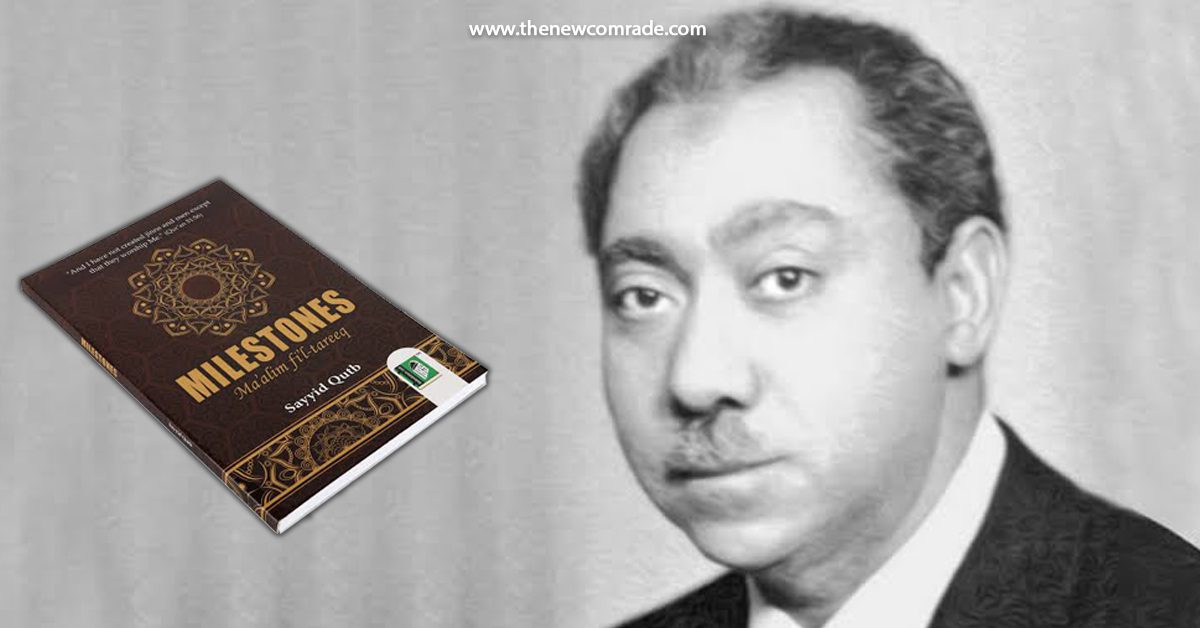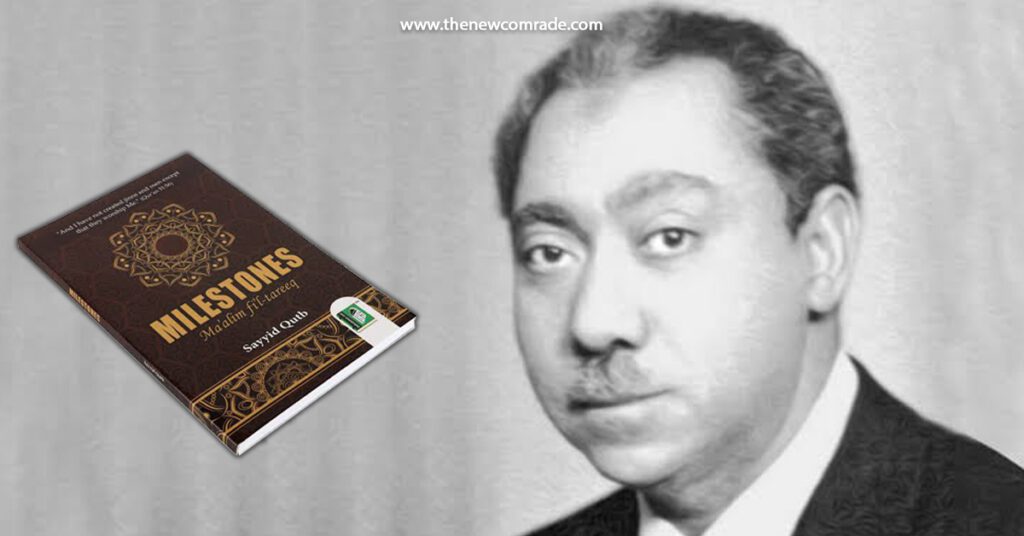
The New Comrade pays respectful tribute to Sayyid Qutub on the occasion of 60th anniversary of his maryrdom on August 29, 2026
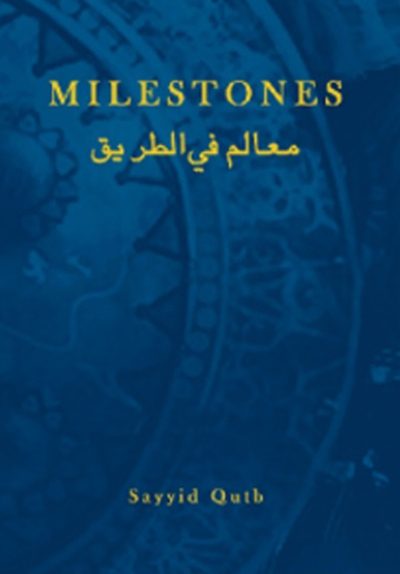
Sayyid Qutb’s ‘Milestones’ (‘Ma’alim fi at-Tariq’) — first published in Arabic in Cairo in 1964 by Dar al-Shorouq — is one of the most consequential works of Islamic political thought produced in the twentieth century CE. Written largely during Qutb’s protracted imprisonment under the regime of Egyptian military dictator Gamal Abdel Nasser (1918–1970) — a period of immense personal suffering that included torture, hard labour, and the slow death of hope in any secular or nationalist solution — the book is, at its core, a manifesto of sacred purpose. It was not written for the leisurely reader of theology, nor for the detached academic surveying the landscape of jurisprudence from a distance. It was written, as Qutb himself declares in the opening pages, for a vanguard: a small, dedicated, spiritually tempered band of people who perceive the depth of the crisis facing humanity and who are prepared to walk the long road back to Allah Almighty’s sovereignty on earth.
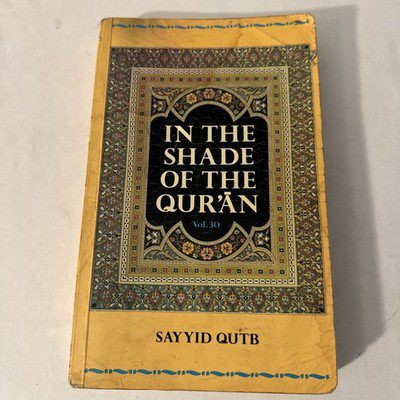
The book draws extensively on Qutb’s monumental multi-volume Qur’anic commentary, ‘Fi Zilal al-Qur’an’ (‘In the Shade of the Qur’an’), condensing and sharpening its arguments into a lean, urgent programme for Islamic revival. Spanning twelve interconnected chapters, *Milestones* moves with cumulative force: from a diagnosis of global civilisational collapse, through a recovery of the prophetic method and the unique spirit of the first Qur’anic generation, to a bold restatement of the doctrine of divine sovereignty, the meaning of true civilisation, and the nature and purpose of jehad. Its literary style bears the passionate rhythms of a man who was first a poet and literary critic before he became a political activist and leader. Qutb’s sentences do not merely argue — they insist, they condemn, they exhort, they illuminate. The book is, in sum, a vision of the world as it is and as it must become. The present review is written in the spirit of the book itself — that is, it endeavours to let Qutb’s own voice, his categories, his arguments, and his passionate convictions speak without the distorting prism of external criticism. Page references are drawn from the English-language edition.
Egypt Under Nasser
No reading of ‘Milestones’ can be properly situated without an understanding of the political crucible in which it was forged. Sayyid Qutb (1906–1966) began his career as a literary figure — a poet, novelist, and a highly respected literary critic within Egypt’s cultural establishment, and for a time an employee of the Egyptian Ministry of Education. His height in literary circles could be understood by the fact that he was the editor of the most respected contemporary literary magazine of Egypt and was instrumental in even popularising the future Nobel laureate Naguib Mahfouz. He grew up in a period of tense political developments throughout Arab and Muslim worlds – World War 1, abolition of the office of Caliphate, imperialist occupation of all Muslim lands, drawing up of nation-states by the imperialist powers, passage of Egypt into England’s protection status, creation and bloody surging of the Palestinian issue, World War 2, etc. Between 1948 and 1950 he was sent to the United States on an educational mission – to study curriculum design in Colorado, Washington D.C., and California. The experience proved formative in an unexpected way: rather than drawing him toward the secular modernity he encountered, it left him deeply disillusioned with what he perceived as the racial prejudice, materialism, and moral permissiveness of American society, and it sharpened his conviction that the West had nothing of spiritual substance to offer the Muslim world. This period also coincided with the first Arab-Israeli war, the Nakba, the hunting of volunteers who returned to Egypt, the banning of the prime mass national movement of Egypt at the time, viz. Muslim Brethren (Ekhwan el-Muslimun), assassination of its head, viz. Hasan al Banna, etc. He witnessed in the United States, how the media and Zionists there rejoiced at that assassination, even calling Banna ‘a terrorist’ (one of the earliest usages of that term). He returned to Egypt in 1950 upon the conclusion of his mission, and, soon thereafter, joined the Muslim Brethren, quickly rising to prominence as the editor of its newspaper and as a leading voice and organiser of the organisation.
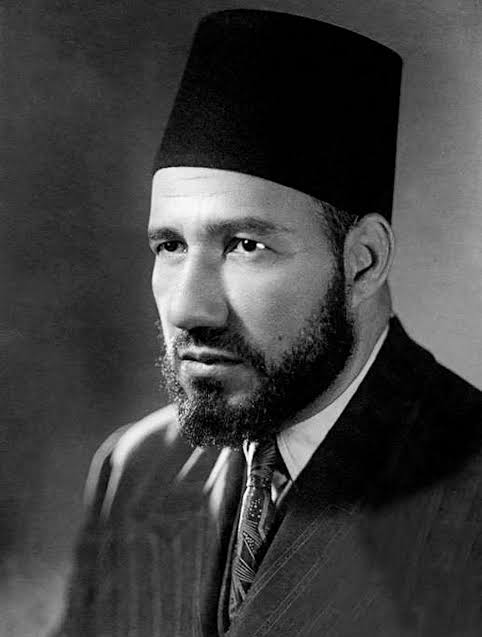
The political order Qutb inhabited was itself in violent transition. The British-backed King Farouk was obsessed with hunting down those who had volunteered in the Palestinian war and voiced support for that cause. British troops were attacked in Alexandria. Ahmed Maher, a pro-British parliamentarian, was shot dead. Ahmed el Khazindar, the Deputy Prosecutor General who had presided over the sentencing ‘Brethren’ to life terms with hard labour was similarly shot dead. Cairo Police Chief Selim Zaki was killed. Farouk’s Prime Minister, Mahmoud Fahmi al Nuqrashi, declared banning the ‘Brethren’ and confiscating their assets. When a massive crackdown was unleashed upon them, Nuqrashi himself was assassinated. Banna’s assassination came after a month and half.

In such a tense atmosphere, Sayyid was soon involved with the ‘Free Officers’, a clandestine group of nationalist army officers, many of whom had pledged their allegiance to the ‘Brethren’, which they would soon renege upon, since grassroots network and moral authority they wielded would prove a necessary stepping stone for building their own popularity. In July 1952, the ‘Free Officers’, led by Muhammad Naguib, overthrew the monarchy of Farouk and replaced him with his infant son Fuad, with his cousin Abdel Moneim as the regent. Ali Maher, an ex-Wafdist, who had been deposed as Prime Minister and arrested ten years prior by Farouk, was reinstated as the Prime Minister. A Revolutionary Command Council was formed by the ‘Free Officers’ to serve as the de facto rulers. Qutb was initially the sole civilian member of this Council. This alliance, however, proved short-lived. Progressively the military members began displaying authoritarian tendencies and taste for corruption. As Naguib mentions in his memoirs, the military members were soon amassing wealth and luxuries. In the first stage, Prime Minister Maher was deposed. Naguib was additionally made the Prime Minister by the Council. Soon thereafter, the King was deposed and Egypt was declared a Republic, with Naguib as its President and Nasser, who was only a junior military officer, as Prime Minister. Nasser and the Brotherhood held fundamentally incompatible visions for Egypt’s future: Nasser sought a one-party, state-directed order with a rhetoric of Arab nationalism, Pan-Arab socialism, and centralised military authority, that would govern the space of Islam rather than governing by it while the Brotherhood sought preserving the Islamic nature of law and society, social justice and a multi-party democratic order. By 1954, Nasser consolidated power and with aid of the other junior military members, deposed Naguib and declared himself the joint President and Prime Minister of the Republic. Initially, with this declaration, the Brethren organised massive demonstrations, calling for the reinstatement of Naguib. The future that lay, looked obvious. Sayyid Qutb and Abdel Quader Oudah were requested to ask the Brethren to disperse, which they did on the assurances of formally considering their demands soon. However, this turned out to be a trap. The relationship between the regime and the Brotherhood curdled into open hostility. The future course of events seemed obvious. In the meantime, Nasser was allowed by the British to recruit Nazi officials from Nurmeberg to devise the torture and propaganda methods. A new intelligence agency was formed under his colleague at the revolutionary council, Zakariya Mohieddine. Three other colleagues at the revolutionary council, viz. Salah Salem, Anwar el Sadat (Nasser’s successor as President) and Husein el Shafei would preside over the military court that would judge against the Brethren. The Anglo-American connections of Nasser and his coterie were all too clear. Soon he was in league with Josip Tito, Jawahar Lal Nehru, Achmed Soekarno, etc. in the Bandung Conference and subsequently the ‘Non-Aligned Movement’ – each of them had a considerable amount of blood of Muslims on their hands. Even at the height of Stalinist repression, he went on to create military and technical cooperation with the USSR. He would soon occupy Gaza and banish the Palestinian government and deport its leaders. In 1956, he led Egypt to a colossal military defeat losing the whole of Sinai and Gaza to the Zionist State, in sharp contrast to the iron fist he flexed domestically. US President Dwight Eisenhower would intervene, through the United Nations, to minimise the impact of this defeat, as part of their providing breathing space for him, which were viewed quite vital for their agendas. There was also a bloody war waged by him in Yemen and a failed unity with Syria, which only served to extend the repression methods he had initiated in Egypt to the rest of Arab states. While this repression, defeats and economic deterioration characterised Nasser inside Egypt, there was no dearth to his rhetoric, peppered with glory of Arab nationalism and need to earn independence from imperialism, in his speeches – many of them broadcast over radio, which earned him immense fandom throughout the region. It may be interesting that Nasser was a drama actor before being a military officer.
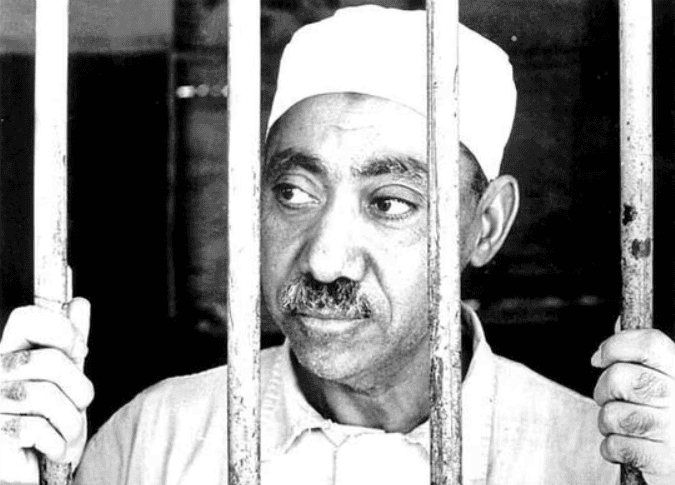
The rupture between the Brethren and Nasser became technically irreversible on 26 October 1954, when a ‘Brethren’ member allegedly attempted to assassinate Nasser during a public rally in Alexandria’s Manshiya Square. Its political effect was immediate and total: The Muslim Brotherhood was outlawed, its assets confiscated, and a sweeping wave of arrests swept up thousands of its members. Military court, as mentioned earlier, trying civilians itself was a matter unusual in the conduct of states. Qutb, despite having been in poor health and being hospitalised at the time, was among those detained. He would spend most of the next decade — with a brief interval of release in 1964 — moving through Nasser’s prison system, including the notorious Tora prison complex south of Cairo, where politically suspect detainees were held under a regime of forced labour, overcrowding, and frequently brutal treatment. Historical accounts, including those of fellow prisoners, describe beatings, attacks by prison dogs, and a 1957 incident in which guards opened fire on inmates during a work detail, killing more than twenty Brotherhood prisoners — an event that seared itself into the collective memory of the movement and, probably, into Qutb’s own imaginations. Soon Nasser banned all political parties, other than his own.
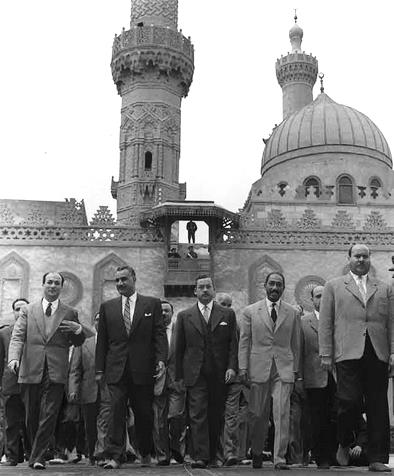
It was within this atmosphere of state terror, physical sufferings, deterioration of economy, nepotism and corruption, and the wholesale collapse of any prospect for peaceful political accommodation with the ruling regime that Qutb composed ‘Milestones’, smuggling chapters out in fragments that circulated first among fellow prisoners and sympathisers before their eventual publication in 1964. The book’s central thesis — that no meaningful distinction of degree exists between a professedly Muslim government and an avowedly secular one, and that both may equally constitute Jahiliyyah — cannot be separated from Qutb’s direct experience of a self-declared Arab and, in its own rhetoric, occasionally Islamic state that had nonetheless subjected dissenters to imprisonment, torture, and death. Nasser’s Egypt, for Qutb, was not an aberration to be corrected through political reform; it was living proof of his central claim that human sovereignty, once entrenched, would always turn its coercive power against those who asserted Allah Almighty’s sovereignty in its place.
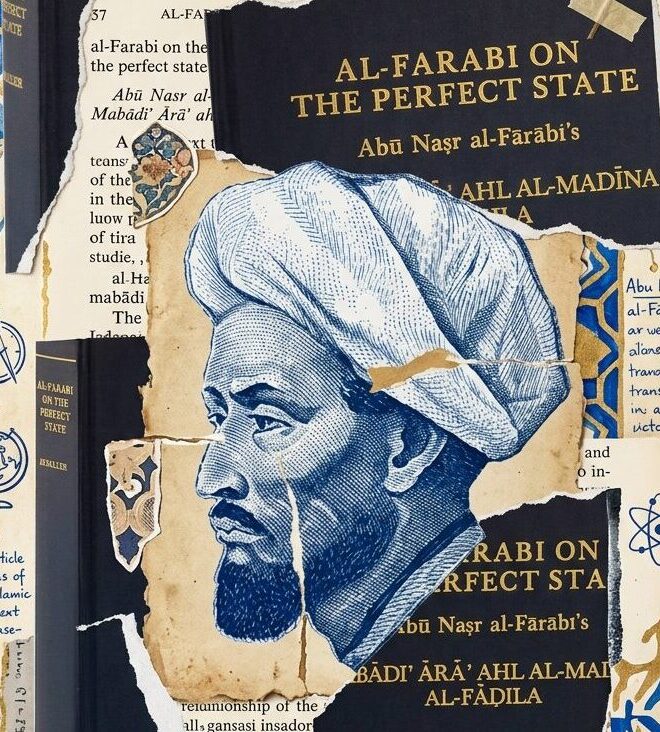
The publication of ‘Milestones’ in 1964, during Qutb’s brief release from prison, did not go unnoticed by the regime. Nasser’s government regarded the book’s uncompromising language — its explicit division of the world into Islam and Jahiliyyah, its call for a vanguard prepared to confront the existing order, and its discussion of jihad as a tool for dismantling structures of human tyranny — as tantamount to a call for revolution against Nasser’s order itself. Here he uses the language of the 10th century philosopher Abu Nasr Mohammed al Farabi’s “Virtuous City” (“Ara Ahl al-Madina al-fadila”) – be it ‘sovereignty’ or ‘jahiliyyah’. With this work, Sayyid reclaimed the epistemological ground of Islamic thought with immense strength, after having been marginalised by the various intellectual productions since the beginning of imperialism. In August 1965, Qutb was rearrested along with hundreds of other Brotherhood members on charges of conspiring to overthrow the government, with ‘Milestones’ introduced at trial as central evidence of seditious intent. Convicted by a special military tribunal in 1966, Qutb was sentenced to death and executed by hanging on 29 August 1966, alongside two fellow defendants. His execution, rather than extinguishing the influence of his final work, transformed ‘Milestones’ into a text sealed by martyrdom — read by subsequent generations of Islamist activists not merely as a work of political theology but as the testament of a man who had paid with his life for the convictions the book articulates.
The Diagnosis: Humanity at the Brink
Qutb opens ‘Milestones’ with a declaration that has the unmistakable quality of a prophet surveying the age. The very first lines of the book situate humanity in a condition of terminal crisis — not a crisis of technology or political organisation, but a crisis of the soul:
“Mankind today is on the brink of a precipice, not because of the danger of complete annihilation which is hanging over its head — this being just a symptom and not the real disease — but because humanity is devoid of those vital values which are necessary not only for its healthy development but also for its real progress.” (p. 9)
The distinction between symptom and disease is characteristic of Qutb’s analytical method. He is never content with the surface of things. The nuclear threat, the arms race, the competition between capitalist and communist blocs — all of these are, for him, symptoms of a deeper disorder: the loss of those transcendent values that alone make human life genuinely human. Qutb surveys the two dominant civilisations of his age — Western liberal democracy and Eastern Marxism — and finds both wanting, not merely as political systems but as ways of life grounded in a particular understanding of the human person.
He notes that Western democracy has become “infertile to such an extent that it is borrowing from the systems of the Eastern bloc, especially in the economic system, under the name of socialism” (p. 9). Marxism, for its part, despite its initial appeal to millions across both East and West, “is defeated on the plane of thought” (p. 9). Its materialistic economic system — the only real foundation upon which its entire structure rested — is, in Qutb’s account, visibly failing. Russia, the leader of the communist world, must import food from abroad and sell its gold reserves, this from a nation that once produced surplus harvests. The failure of collective farming, in his reading, is the failure of “a system which is against human nature” (p. 9). Interestingly, Nasser had himself implemented certain land ownership laws in Egypt and it had hurt the economy of Egypt quite hard.
The conclusion Qutb draws is both sweeping and, within his framework, inescapable: the world is in urgent need of a new leadership. Not a new political party, not a reformed economic model, not a technocratic administration, but a genuinely new leadership of ideas, values, and moral orientation. And that leadership, Qutb argues with absolute conviction, can come only from Islam — not Islam as it has been practised amid the historical compromises and spiritual laxity of the centuries since the first generation, but Islam as it was revealed, as it was received by that unique Qur’anic generation, and as it can be recovered by those with the courage to walk the path of total commitment.
The Concept of Jahiliyyah: The Condition of the Modern World
The single most intellectual contribution of ‘Milestones’ is Qutb’s radical redeployment of the classical Islamic concept of Jahiliyyah (“Ignorance”). In the traditional lexicon of Islamic scholarship, Jahiliyyah refers to a specific historical period of pre-Islamic Arabia — a time of polytheism, tribal violence, the burying of infant daughters, and a comprehensive ignorance of divine guidance. It was the age that the revelation of the Qur’an came to transform and transcend. As mentioned earlier, Farabi, in his ‘Virtuous City’ mentions about the dichotomy of virtuous cities and jahili cities – which do not know the true human happiness.
Qutb does not dispute this historical meaning. What he does, with the audacity that marks every truly original thinker, is to declare that Jahiliyyah is not merely a historical condition but a perennial one. Any society in which human beings claim sovereignty over one another — in which men legislate for men, in which parliaments and courts and constitutions derive their authority from popular will or historical convention rather than from divine revelation — is, in its essence, a Jahili society. The mere passage of time, the acquisition of material technology, the sophistication of legal codes: none of these alter the fundamental character of a system that excludes Allah Almighty from the domain of governance.
The implications of this redefinition are far-reaching. Qutb writes that contemporary societies, without exception — including those societies that bear the name “Muslim” and whose populations perform their prayers and fast in Ramadan — are, in their structural reality, Jahili:
“The whole world is steeped in Jahiliyyah, and all the marvellous material comforts and high-level inventions cannot mitigate this ignorance.” (p. 12)
More startling still, the Muslim community itself has ceased, in Qutb’s judgement, to be genuinely Islamic in any meaningful sense. “The Muslim community of the past was unique,” he writes; “It was not merely a religious community but a movement for the abolition of everything that was false and the establishment of everything that was true.” That community, that movement, vanished: “The Muslim community with these characteristics vanished at the moment the laws of Allah Almighty became suspended on earth” (p. 5). What exists in the lands called Muslim today, on his account, are not Islamic societies but societies that have borrowed the vocabulary of Islam while constructing their political, legal, and economic orders on human rather than divine foundations.
This argument has an internal logic that Qutb pursues relentlessly. For him, the declaration “La ilaha illa Allah” — there is no deity but God Almighty — is not a pious formula to be merely recited at prayers. It is a political and social manifesto: the proclamation of Allah’s exclusive sovereignty over all of human life, and therefore the rejection of every other claim to sovereignty. In Qutb’s words, this declaration “was a challenge to that worldly authority, which had usurped the greatest attribute of Allah, namely, sovereignty… a declaration of war against that authority which legislates laws not permitted by Allah Almighty” (pp. 20–25). To say “La ilaha illa Allah” and then to live under a parliamentary democracy or a military dictatorship is, in his view, a contradiction that empties the testimony of its meaning.
The Unique Qur’anic Generation and the Method of Revival
Having established the depth of the present crisis, Qutb turns to history for a model of recovery. The first and most crucial question he poses is this: what made the first generation of Muslims — the companions of the Prophet Mohammed SAAWS — so uniquely transformative? They were, after all, human beings like every generation before and after them. What enabled them to achieve, within a single lifetime, a revolution that changed the moral geography of the world?
Qutb’s answer is threefold, and each element of his analysis carries lasting weight. The first and most fundamental reason was the absolute purity of their source. They drew their understanding, their values, their moral convictions, and their practical guidance from one source alone: The Qur’an, as it was being revealed to them. They did not mix this source with Greek philosophy, Persian mysticism, or the cultural assumptions of their tribal past. They did not read the Qur’an alongside other texts, weighing it against competing frameworks or evaluating it from the perspective of pre-existing commitments. For them, the Qur’an was the only map of reality that mattered.
The second reason was the spirit in which they approached the text. They did not read it for intellectual enrichment, aesthetic pleasure, or academic exercise. As Qutb writes, “they did not read it for the sake of discussion or for the sake of enjoyment… they read it to find out what the Almighty Creator had prescribed for them” (p. 16). In their relationship to the Qur’an, they were like soldiers receiving orders before a campaign: every verse was immediately actionable, every command immediately binding. When a verse descended, prohibiting something they had previously cherished, they abandoned it without argument. When a verse commanded something difficult and dangerous, they undertook it without hesitation.
The third reason was the completeness of their break with the past. Upon embracing Islam, the companions made a rupture with the Jahili world that had formed them — its loyalties, its hierarchies, its values, its social structures. They did not attempt to synthesise Islam with the old order; they replaced it.
The Qur’anic Method: Faith Before System
From this analysis of the first generation, Qutb derives what he calls the Islamic methodology: the divinely ordained method for establishing Islam in any age. The cornerstone of this methodology is a sequence that the Qur’an itself modelled — the absolute priority of faith over system, of aqidah over shari’ah, of spiritual formation over legal implementation.
He notes that for the first thirteen years of the prophetic mission — the entire Meccan period — the Qur’an dealt with essentially one question: the uniqueness of Allah Almighty (tawhid) and the demand for submission to His sovereignty. It did not legislate for commerce, family life, or political organisation. It did not promise national liberation from the Romans or the Persians. It did not begin with social reform or economic redistribution. It began with, and for thirteen years sustained its focus on, the one irreducible truth: “There is no deity but God.”
Qutb uses a striking image to convey the logic of this sequence:
“Its system extends into all aspects of life; it discusses all minor or major affairs of mankind; it orders man’s life — not only in this world but also in the world to come… It is thus like a tall, strong, wide-spreading tree; clearly its roots must go down deep and be in proportion to its size.” (p. 34)
A tree whose branches reach toward heaven and whose shade covers vast distances cannot be sustained by shallow roots. The branches — the legal, social, economic, and political institutions of an Islamic order — can only grow and flourish in proportion to the depth of the roots, which are the faith and spiritual character of the community that bears the tree. To attempt to build the legal and institutional superstructure of an Islamic state upon a community whose roots of faith have not yet gone deep is, on this account, to plant a tree in sand: it will wither.
This is why Qutb insists, with a rigour some readers have found surprising, that the implementation of Islamic law is not the objective of Islamic revival but its culmination. Laws would develop once the community is ready to live by them, more than as an external imposition, as the natural expression of its own deeply rooted convictions.
The Inseparability of Knowledge and Practice
One of the subtler but more philosophically significant arguments of *Milestones* concerns what Qutb calls the “Islamic concept” — a term, by which he means the comprehensive worldview, or orientation to reality, that Islam engenders in those who embrace it fully. The Islamic concept is not merely a set of beliefs held in the mind, nor a code of conduct observed in daily behaviour. It is the indissoluble unity of both: a way of knowing the world that is simultaneously a way of living in it.
Qutb writes that one cannot truly understand Islam unless one is also practising it — and, conversely, one cannot practise it authentically unless one’s understanding of it is genuine. This is not a circular argument but a description of a particular kind of knowledge: participatory knowledge, knowledge from within. The Qur’an, on his account, is not a theoretical text to be read from the outside, in the manner of a scholar studying an ancient civilisation. It is a living address from God to the human person, and its full meaning can be received only by one who is, in Qutb’s words, “ready to act on its guidance” (p. 43).
This insight carries direct consequences for the methodology of Islamic revival. It means that the process of recovering true Islamic life cannot begin with academic theology or legal analysis. It must begin with a genuine act of submission — the decision, by the individual and then the community, to place themselves entirely under the sovereignty of God. From that act of submission, understanding will deepen; and from deepening understanding, the community’s capacity to live the full dimensions of Islam will grow.
Qutb states with characteristic directness: “This religion has come to change not only the beliefs and practices of people but also the method of bringing about these changes… This religion cannot be established — at any time — except through this method” (p. 43).
The Sovereignty of Allah and the Freedom of Humanity
The intellectual heart of ‘Milestones’ is the doctrine of Hakimiyyah: the ultimate sovereignty of God. This is, for Qutb, not one doctrine among many but the foundation on which the entire edifice of Islamic thought and life is constructed. Every other concept in the book — Jahiliyyah, the vanguard, jihad, the Islamic concept, true civilisation — could be understood only against the background of this foundational commitment.
‘Hakimiyyatallah’ means, in its most precise formulation, that the right to legislate, to govern, to command, and to forbid in the domain of human life springs from Allah Almighty. Any human claim to these prerogatives — whether made by a king, a parliament, a party, or a tradition of customary law — is, in Islamic terms, shirk: the association of partners with Allah Almighty in His most essential attribute. Qutb does not soften this conclusion. He states it with the clarity that, he believes, the Qur’an itself demands:
“To declare the sovereignty of Allah means the complete eradication of man-made laws and the elimination of the authority of all human beings who legislate for others, without any authority from Allah.” (p. 58)
Yet it would be a serious misreading of Qutb to interpret Hakimiyyah as a form of political despotism dressed in religious language. For him, the sovereignty of Allah is the condition of the freedom of humanity. Under any system in which human beings claim sovereignty — whether through democratic majorities, revolutionary parties, or hereditary dynasties — some human beings will inevitably dominate others. The laws of the powerful will be imposed upon the weak; the interests of the ruling class will be enshrined as the law of the land; and the vast majority of human beings will live in a condition of servitude to their fellow creatures. This, for Qutb, is the fundamental injustice of Jahiliyyah.
Under the sovereignty of Allah Almighty, by contrast, no human being can claim authority over another except on the basis of the divine revelation that applies equally to ruler and ruled. The submission of all to Allah’s law is, paradoxically, the liberation of each from the domination of any. In Qutb’s words, Islam represents “the universal declaration of the freedom of man on earth from every authority except Allah” (p. 48).
Islam and Jahiliyyah: A Division That Admits No Compromise
One of the most arresting passages in ‘Milestones’ comes in the discussion of the relationship between Islam and Jahiliyyah — a relationship Qutb characterises as one of absolute, irreconcilable opposition. He is unsparing in his insistence that there is no middle ground, no synthesis, no accommodation between the divine order and any system that displaces Allah from the centre of human life:
“It is not the function of Islam to compromise with the concepts of Jahiliyyah which are current in the world or to coexist in the same land together with a jahili system. This was not the case when it first appeared in the world, nor will it be today or in the future… Islam cannot accept or agree to a situation which is half-Islam and half-Jahiliyyah. In this respect Islam’s stand is very clear. It says that the truth is one and cannot be divided; if it is not the truth, then it must be falsehood. The mixing and co-existence of the truth and falsehood is impossible. Command belongs to Allah, or otherwise to Jahiliyyah; Allah’s Shari’ah will prevail, or else people’s desires.” (pp. 144–145)
This passage offers a window into the logical structure of Qutb’s entire argument. Islam, as he understands it, is not something that could be merely practised privately while the public square is governed by secular arrangements – the former itself would be unsafe from the latter. It is not a set of spiritual disciplines pursued in the mosque while the marketplace, the courtroom, and the parliament operate on other principles – the former would not sustain uncorrupt under the latter. It is a comprehensive system — a total way of life — that either governs the whole of human existence or is not, in Qutb’s strict sense, Islam at all.
The argument has deep roots in Islamic theology. The unity of God (tawhid) implies, for Qutb, the unity of the domain over which Allah Almighty’s authority extends. To acknowledge Allah Almighty as sovereign in the domain of personal worship while acknowledging human authority as sovereign in the domain of law and governance is, in effect, to divide reality into a sacred sphere and a secular sphere, and to deny divine sovereignty over the latter. This is, in Qutb’s reading of the first pillar of the Islamic creed, precisely what “La ilaha illa Allah” forbids.
The Vanguard: The Living Nucleus of the New Muslim Community
Having established both the depth of the crisis and the nature of the remedy, Qutb addresses the most practical question of all: who will carry out the work of revival, and how? His answer centres on the concept of the vanguard — a dedicated community of believers who have internalised the Islamic concept, made a genuine break with the values and assumptions of ‘Jahili’ society, and committed themselves to walking the path of prophetic methodology.
Qutb is transparent about the intended audience of his book: “I have written “Milestones” for this vanguard, which I consider to be a waiting reality about to be materialised” (p. 12). The vanguard is not, in his conception, a secret organisation or a conspiratorial cell, though it is a community set apart. It is set apart not by hostility toward the human beings around it, but by the clarity of its vision, the depth of its faith, and the integrity of its commitment to live according to divine rather than human standards.
The vanguard must cultivate two qualities above all others. The first is spiritual depth: a thorough grounding in the Qur’an, approached not as an academic text but as a living address from Allah Almighty, demanding immediate and total response. The second is methodological fidelity: the commitment to follow the prophetic method in its sequence, meandering through formation of individual and communal faith to transformation of social and political structures.
Qutb draws an explicit parallel with the Meccan phase of the prophetic mission. For thirteen years, the Prophet and his companions endured persecution, social ostracism, and physical suffering prior to an armed action. They preached, they endured, they deepened their faith, and they waited for the moment of Allah Almighty’s choosing. The vanguard of every subsequent age, on Qutb’s account, must be prepared for a similar period of patient formation. There are, in his view, no shortcuts in the divine methodology.
Jihad in the Path of Allah: A Dynamic and Comprehensive Doctrine
No reading of *Milestones* can be complete without careful engagement with Qutb’s extended discussion of jihad. Qutb’s treatment of this subject is more nuanced and philosophically developed than is often appreciated by those who cite it in polemical contexts.
He begins by ripping apart the “defeated” and “apologetic” reading of jihad as mere defensive warfare. This reading, he argues, reduces Islam to a system of mere self-preservation and fails to grasp the universal character of the Islamic mission. Islam, in his account, is not a regional religion or a national ideology; it is a message addressed to all of humanity, bearing a claim to universal truth and liberation. A religion with a universal message, he contends, cannot confine its activity to the defence of a particular territory.
At the same time, Qutb is careful to distinguish between the compulsion of belief — which Islam explicitly forbids — and the removal of political and institutional obstacles to the free hearing of the divine message. “There is no compulsion in religion” (Qur’an 2:256) is, for him, an absolute principle: no human being may be forced to believe. But it does not follow, on his reasoning, that oppressive political systems which prevent people from freely encountering and choosing Islam, as divinely honoured equals, must be left undisturbed. The physical infrastructure of Jahiliyyah — the armies, the laws, the institutions that enforce the sovereignty of man over man — must be dismantled, so that human beings could hear the divine message and respond to it, all in a liberated free space.
Qutb writes:
“Islam is not a defensive movement, in the narrow sense in which the word ‘defence’ is used today… It is a movement to establish the freedom of man on earth by eliminating all human tyranny… Those who say that Islamic Jihad was merely for the defence of the ‘homeland of Islam’ diminish the greatness of the Islamic way of life and restrict the all-encompassing and far-reaching mercy which Islam wants to extend to all mankind.” (pp. 62–63)
Jihad, in Qutb’s comprehensive vision, takes multiple forms depending on the stage of the vanguard’s development. In the earliest stages, it is the struggle to bear witness to the truth of tawhid in the face of social and political hostility: preaching, enduring, and not wavering, community formation, message communication, use of force to remove the tyrannical structures that prevent human beings from living freely under Allah’s sovereignty. The goal, as he frames it, is not conquest but liberation; not the imposition of belief but the creation of conditions in which intellectual choices are made in honour and freedom.
True Civilisation: The Islamic Standard
In one of the most intellectually ambitious chapters of the book, Qutb challenges the Western conception of civilisation and proposes a radically different criterion by which human cultures should be evaluated. The Western definition, he argues, is fundamentally materialistic: it measures civilisation by levels of technological development, economic productivity, and institutional sophistication. By these criteria, modern Western societies rank highest, and the pre-modern Muslim world appears backward.
Qutb rejects this framework entirely. The criterion of true civilisation, he argues, is not material but moral and spiritual: a society is civilised to the extent that it is organised around the freedom of the human person from servitude to other human persons. And since servitude to other human persons is the essential characteristic of every Jahili system, true civilisation can be achieved only under the sovereignty of Allah Almighty.
A genuinely Islamic society, in his vision, is one in which the distinctions of race, nationality, language, and class that divide humanity in the Jahili order are transcended by the unity of submission to God. It is a society in which every human being, regardless of origin, stands in the same relationship of servitude and dignity before the one Creator. This, Qutb argues, is the only foundation on which genuine human equality can be built — not the abstract equality of democratic ideology, which coexists comfortably with vast inequalities of power and wealth, but the real equality of persons before God.
On the relationship between Muslims and the learning of non-Muslims, Qutb is more pragmatic than is sometimes recognised. He acknowledges freely that Muslims may and should learn from non-Muslim sources in the domain of the natural sciences, technology, and practical administration. What they may not do, on his account, is derive their understanding of faith, morality, human relationships, or the interpretation of history from non-divine sources. The tree of technical knowledge is one thing; the roots of spiritual and moral life are another.
The Homeland of the Believer and the Question of Nationality
‘Milestones’ contains a bold and striking argument about the nature of the Muslim’s homeland and the claims of national identity. For Qutb, the ties of blood, soil, language, and shared historical memory that constitute nationality in the modern sense are not the proper basis of the Muslim’s deepest loyalties. These ties are, in his characteristically direct phrasing, “residues of the primitive state of man” (p. 118): forms of attachment that belong to the Jahili order and that are transcended — not destroyed, but rightly ordered — by the Islamic commitment.
The Muslim’s true homeland, on this account, is not the land of his birth or the imperialist defined nation-state to which his passport belongs. It is ‘Dar al-Islam’: the domain in which Allah Almighty’s sovereignty is acknowledged and His law is operative. Any land in which Allah Almighty’s law is not dominant is ‘Dar al-Harb’ — not necessarily the object of immediate military action, but not the believer’s true home. The Muslim community, in Qutb’s conception, is a community defined by faith rather than by geography or ethnicity: a community that extends, in principle, to every corner of the earth where there are those who have submitted to Allah Almighty.
This argument carries profound implications for the question of Muslim loyalty to contemporary nation-states, including Muslim-majority states that operate on foundations laid by the imperialists. Qutb does not tell his readers specifically that they should work to overthrow their governments by any means available; but he does tell them that the deepest claims on their loyalty are not national but theological, and that no earthly state can rightfully claim from them the absolute submission that belongs to Allah Almighty alone.
The Faith Triumphant: Story of the ‘People of the Pit’
‘Milestones’ does not end on a note of political strategy or institutional blueprint. It ends, with characteristic spiritual depth, on a meditation on the nature of true victory — and true victory, Qutb argues, has nothing to do with worldly success, political power, or numerical strength.
He reflects at length on the Qur’anic story of the ‘People of the Pit’ (‘Ashaab al-Ukhdood’ in Surah al-Buruj), which is, as per a narrative, a group of believers thrown into a fire trench by a tyrant who demands that they renounce their faith. They refuse. They die in the fire. They receive no worldly rescue, no miraculous deliverance, no subsequent political vindication. The tyrant wins, by any worldly measure.
And yet, Qutb argues, the believers were victorious — completely, irreversibly, and eternally victorious. They were victorious because they proved, in the most extreme imaginable test, that their love for Allah and their commitment to the truth of His sovereignty were greater than their love of life, comfort, and safety. They conquered fear. They conquered pain. They conquered the seductive power of the world’s allurements. And in doing so, they demonstrated the one thing that Jahiliyyah, with all its armies and institutions and propaganda, can never demonstrate: that there are human beings for whom the truth of Allah is worth more than everything the world can offer or threaten.
This is the ultimate lesson of *Milestones*: that the struggle for divine sovereignty on earth is, at its deepest level, a struggle of the spirit before a struggle for power — a struggle of faith against fear, of eternal conviction against temporal calculations. The vanguard Qutb addresses, is called to spiritual transformation primarily preceding political action : the transformation of individuals who have made, at the deepest level of their being, the choice for Allah Almighty.
Qutb writes with the luminous certainty of a man who had made that choice himself, in a prison cell, under the shadow of the gallows: “life without belief is worthless” (p. 160). It is this conviction — articulated with the authority of one who lived by it and died for it — that gives ‘Milestones’ its enduring power.
The Road and Its Milestones
‘Milestones’ is, in the end, a book about orientation. It is about the recovery, by a generation that has lost its bearings, of the road that leads toward Allah Almighty, and the identification of the milestones that mark that road and tell the traveller how far he has come and how far he must go.
The milestones Qutb identifies are spiritual and conceptual primarily before being institutional or political : the recovery of ‘tawhid’ in its full implications; the recognition of the ‘Jahili’ character of the present order; the commitment to the prophetic methodology in its proper sequence; the formation of a vanguard that has made a genuine break with the assumptions of ‘Jahili’ society; and the patient, faithful, courageous work of preaching, enduring, and building — in Allah’s time and by method taught by Allah Almighty — the community that will one day be capable of embodying His sovereignty on earth.
Qutb concludes with a passage that reads less like the ending of a political manifesto than like the final verse of a long, sustained act of worship:
“It is not the function of Islam to compromise with the concepts of Jahiliyyah, which are current in the world, or to coexist in the same land together with a jahili system… Command belongs to Allah, or otherwise to Jahiliyyah; Allah’s Shari’ah will prevail, or else people’s desires.” (pp. 144–145)
There is, in this conclusion, the absolute quality of the Islamic creed itself: the declaration that there is no reality ultimately worthy of submission except Allah, and that all other claims to ultimate loyalty are, in the end, the claims of a passing age upon an eternal soul. ‘Milestones’ is, from first page to last, the sustained articulation of that declaration — and an invitation to every reader to measure the milestones on the road to Allah.
Bibliography
Qutb, Sayyid. ‘Milestones’. Indianapolis: American Trust Publications, 1990.
Qutb, Sayyid. ‘Fi Zilal al-Qur’an’ (‘In the Shade of the Qur’an’). 6 vols. Leicester: Islamic Foundation, 1999–2009.