What are the major human rights challenges facing India today?
We are passing through a phase in history when every human right guaranteed in the constitution is under challenge. Every civil liberty—be it that of conscience, worship, dissent, media, etc.—is under very severe attack. Increasingly, even the right to vote is under threat. Defending constitutional rights seems to be the biggest current challenge.
In the project of the RSS, it is Muslims who are particularly under attack and, in some regions, Christians too. As such, defense of the rights of religious minorities—to be equal citizens in India—is what deserves primary concern. Even their equal citizenship has been, by now, rendered suspicious.
Hannah Arendt has mentioned citizenship as “the right to have rights.” India’s Muslims have moved to an ever-shrinking space regarding the right to have rights. Somebody could call for genocide of Muslims and no legal action would happen; such persons might even become ministers. With no legal reasons or process, Muslims’ houses are being bulldozed, and they are pushed across the border despite possessing legal documents.
Hence, while the biggest human rights challenge would be the defense of constitutional rights and civil liberties, particular defense of the Muslim community and, in tribal regions, the Christian community ought to be our top priority.
How should we prioritize and address the needs of India’s most marginalized communities?
Mohandas Gandhi, in one of his last months, wrote:
“I will give you a talisman. When you are in doubt, think of the weakest, poorest, most oppressed person that you know. Think of what that you are setting out to do, what will it do to her life?”
I have worked in the government as a bureaucrat and District Collector across six districts. I also worked in the National Advisory Council with the previous government, framing policies and drafting laws. In each of these roles, the most vulnerable person deserved to be at the center of priorities and concern: will this policy improve their lives?
The gap between that principle and the modus operandi of the current regime can be exemplified by the developments during the COVID-19 lockdown. Had the Prime Minister thought about that last person at the receiving end of a policy—a random blind, single, elderly widow in an Adivasi hut, migrant workers, settler migrants, homeless people—he could never have adopted the policies he did during that period.
The very moment I listened to the declaration of lockdown, I wondered about the urban homeless: how would they even eat tomorrow? Hence, I decided that I would disobey the orders and go out onto the streets. “Last person first” ought to be the driver of policy-making, not “last person last.”
What structural and policy reforms are required to strengthen human rights protections in India?
First, there should be no exceptions to human rights—everybody must have the protections of the rule of law, access to bail, and due process. Under the pretext of anti-terror legislation and security maintenance, numerous runarounds have been instituted.
For instance, in conventional procedures, a statement before the police is not admissible as evidence owing to the common knowledge that it could be drawn from torture and coercion. However, in terror laws, this protection has been circumvented. Consequently, people spend many years—even 10 to 15 years—in prison, forced to sign documents under torture that then become the sole basis for legal action against them.
Secondly, we need the enactment of universal social rights. This was something we started pushing for in the National Advisory Council—beginning with the right to food, right to healthcare, right to decent education, right to pensions for older people, and social security. These rights should be guaranteed by law. Even today, when there is ample food in the world, every third child in India is malnourished, which is simply unacceptable.
Combined with these reforms, we would have to tax super-rich feudals and capitalists substantially to generate the resources necessary to provide a decent life for the most disadvantaged citizens.
How do you maintain a clear understanding of hope during such challenging times?
During a public lecture in Aspen, USA, in memory of Nobel Peace Prize winner Albert Schweitzer, I said:
“Hope is a public duty. We cannot afford to lose hope. If you lose hope, then you do not have anything to do—nothing would look possible.”
We need to keep believing that a better world is possible.
I believe, even through the darkest of times, that there is innate human goodness—people who reach out and help. In the middle of the worst anti-Muslim pogroms, we have occasionally come across Hindus who protected Muslims. There were such instances during Delhi’s 1984 anti-Sikh massacres and the 2020 anti-Muslim pogroms. A Sikh man, Mohinder Singh, and his son Inderjeet saved about 70 Muslims, taking them into their home and protecting them.
What critical lessons can society learn from the survivors of targeted hate violence?
One key lesson is that the loss from hate violence is fundamentally different from loss due to a natural calamity. The pain resulting from neighbors joining a mob, supported by the police, to destroy one’s home and kill family members creates what I call “wounds of the soul”—a lifetime is too short for them to heal. It is the duty of any decent state to do everything to stop hate violence.
Healing from this kind of pain relies on four pillars:
- Public Acknowledgement: Recognizing that the violence actually happened. This is regularly negated when, for instance, a lynching occurs in a remote village and the police claim it was not hate violence, but merely an accident.
- Collective Remorse: Expressed by both society and the state. Truth commissions formed in various countries serve this purpose well.
- Reparation: Which goes much further than basic compensation, elevating victims materially to a position better than before. The same applies to persons wrongfully charged with terror crimes who spend years in prison.
- Justice: Without justice, the wounds will simply not heal.
In India, in most incidents of hate violence, none of these occur. There is no acknowledgement, no public remorse, no reparation, negligible compensation, and justice is completely subverted.
What is the fundamental ethical duty of the general public when facing systemic injustice?
When great injustices happen, remaining silent is not a neutral position—it is tantamount to taking sides with injustice. Speaking out, joining hands, and resisting together are imperative for everyone.
Secondly, deep empathy is necessary. If chains are tied on your feet, I ought to feel my freedom has been stolen from me. If somebody is lynched and beaten, I ought to feel the pain on my own back. If a Dalit girl is gang-raped, I ought to feel as though my own child or sibling was attacked. People who are not personally suffering injustices need to feel the pain of the other, stand in solidarity with them, and ensure that justice prevails.
What are the current strengths and limitations of civil society organisations in India?
India is passing through a juncture where the Constitution, its rights, and its guarantees are under deep threat. This situation has evolved because the very institutions supposed to stand in defense of these rights have compromised. The opposition parties, legislatures, judiciary, media, bureaucracy, intellectuals, and universities have all failed us in the protection of human rights.
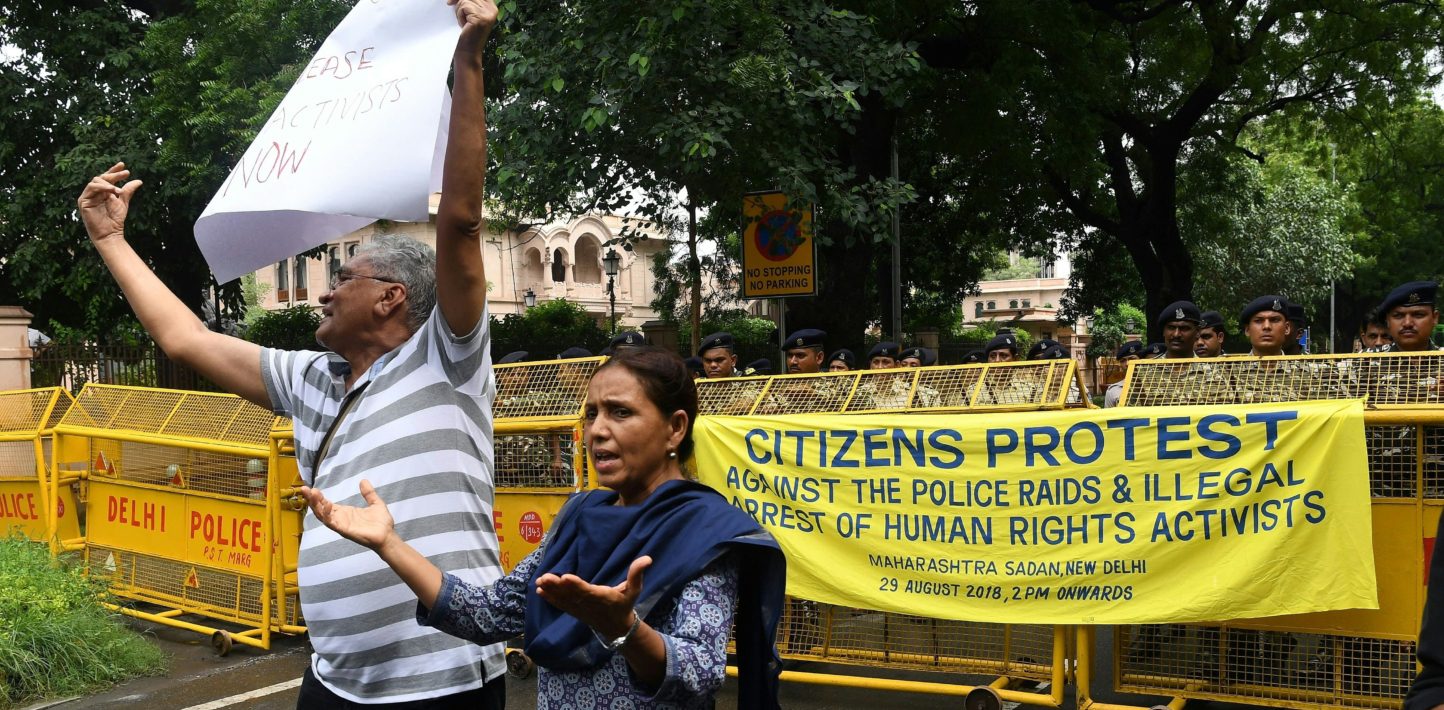
Hence, the primary onus falls on civil society. The Freedom Struggle, the anti-Emergency movement, the anti-NRC protests, and the farmers’ movement were all key moments of mass action and genuine solidarity driven by civil society.
Why is storytelling such a vital tool in the struggle for social justice?
The fight for justice begins when those who are not suffering injustices feel the pain of those who suffer, share it, and stand up together to fight it. Prior to feeling that pain, one needs to imagine it.
We live in a world where I see homeless people every day, but what do I truly know about their lives? Someone who is not a Muslim in these times may not understand what it means to suffer discrimination—to worry about losing citizenship, being deported, put in detention centers, or having a home bulldozed. Similarly, to understand Dalits, one must understand what it means to live with constant humiliation—like a child being beaten for touching a water pot reserved for privileged castes.
For that act of imagination preceding empathy, one needs to know stories. That is why I tell stories: to help people imagine the life of the “other,” share in their pain, and stand firmly in solidarity.
How can we build meaningful dialogue across deep political and social divides?
We are living in highly polarized times, both in India and around the world. Regime leaders routinely abuse, mock, and dismiss dissent, which has unfortunately become the norm. This is very different from post-World War II norms—for example, US President Eisenhower negotiating the “New Deal” framework with unions during difficult periods. Dialogue needs to be rebuilt through processes of respectful engagement.
However, I maintain a caveat to this. People often tell me I should sit down with an RSS representative to have a dialogue. I worry about that because it can be tantamount to giving in to repressive, inhuman forces. There must be defined boundaries for respectful discourse. For instance, you cannot debate someone who believes in the validity of untouchability, opposes women’s rights, or advocates for denaturalizing citizens. Within those foundational human rights bounds, however, there is vast space for meaningful dialogue.
Why is the current model of economic development a dangerous bogey?
Huge wealth is being created today, but wealth disparities have become astronomical. Wages have remained almost stagnant over decades or even declined. Such “development” is meaningless.
Consider a hypothetical scenario where an ultra-wealthy individual spends $1 million every single day without investing it further—that wealth would last thousands of years. Yet, while one person holds that much wealth, 1 in 12 people in the world still sleep hungry, and every second person lacks assured healthcare.
As such, we need to move past this false promise of economic growth and actively articulate and work for a far more just and fair world.