Read Part 03 here
Internal Structure and Membership
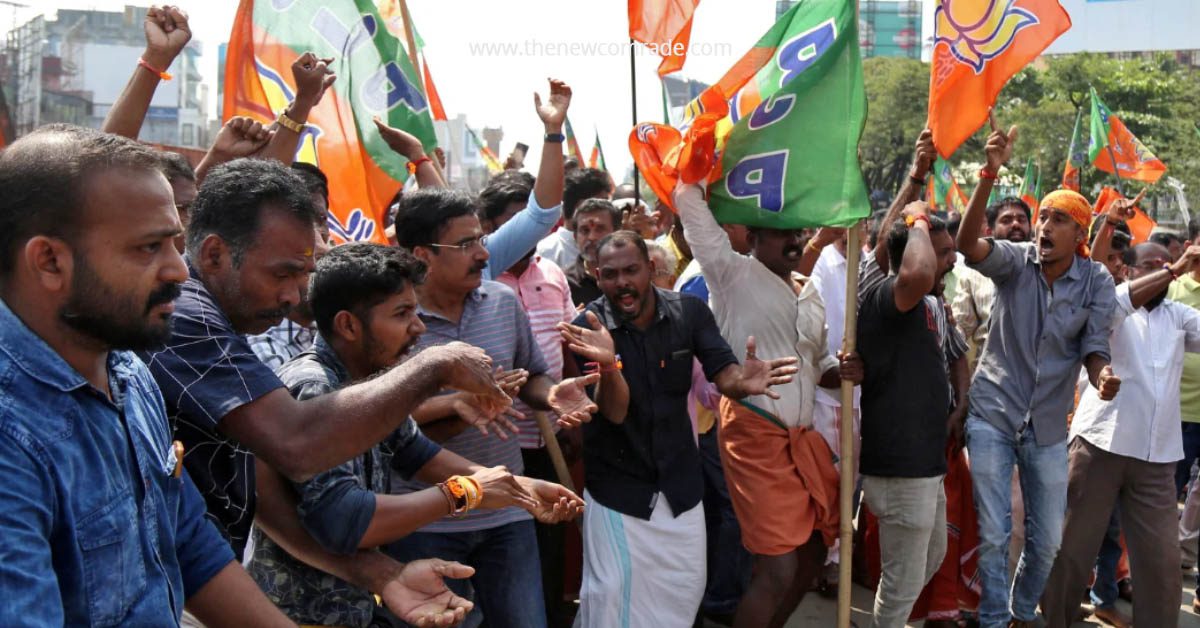
Beneath its senior leadership, the BJP’s Kerala unit is organised, in common with the party’s structure nationally, through a hierarchy of state, district, and mandal, or block-level, committees, each responsible for candidate selection recommendations, local campaign coordination, and membership recruitment within its area. Formal party membership drives, conducted periodically have been used deliberately to expand the party’s nominal membership base well beyond the smaller core of RSS-linked cadre that historically dominated its Kerala organisation, part of a wider effort to build a broader support base capable of sustaining campaigns in constituencies without a strong pre-existing Sangh Parivar presence.
Specialised wings targeting women, through the Mahila Morcha, youth, through the Yuva Morcha, and Scheduled Caste, Scheduled Tribe, and Other Backward Class voters through dedicated cells (the Scheduled Caste Morcha and Other Backward Classes Morcha among them) have similarly been expanded over the past decade, reflecting the same underlying social-engineering logic that produced the BDJS alliance: an explicit recognition that a party reliant solely on its traditional privileged-caste Hindu base could not realistically expect to compete for government in a state with Kerala’s particular social composition.
The 2024 Lok Sabha Breakthrough: Suresh Gopi and Thrissur
The most consequential single electoral event in the BJP’s history in Kerala prior to 2026 occurred in the 2024 Lok Sabha election, when the actor-turned-politician Suresh Gopi won the Thrissur parliamentary constituency, delivering the party its first-ever Lok Sabha seat from the state after more than seven decades of unbroken defeat, dating back to the BJS era. Gopi’s victory was emphatic rather than marginal: he polled 412,338 votes against 337,652 for the Communist Party of India’s V. S. Sunilkumar and 328,124 for the Congress’s K. Muraleedharan, securing a margin of 74,686 votes in a genuinely triangular contest.
Gopi’s campaign combined the candidate’s long-cultivated public image as a philanthropist, built through five years of charitable work in Thrissur, including the renovation of the city’s Sakthan market using funds from a trust established in memory of his late daughter, with an intensive national campaign effort that included multiple rallies addressed by Narendra Modi. This was Gopi’s third attempt at the seat, having previously lost the same Lok Sabha constituency in 2019 and the corresponding Assembly seat in 2021, and analysts attributed his eventual success to a combination of accumulated local credibility, an emphasis on development themes such as a proposed extension of the Kochi Metro to Thrissur, and an unusually broad coalition of support that extended into sections of the Christian electorate, reflected in symbolic gestures, such as his donation of a crown to a shrine during the campaign. The NDA’s aggregate vote share across Kerala reached approximately 19.2 per cent in the 2024 election, its highest recorded level in the state to that point, even though the BJP’s gains remained heavily concentrated in Thrissur and a small number of other constituencies, including Thiruvananthapuram, where Rajeev Chandrasekhar came within some 15,000 votes of unseating the sitting Congress MP Shashi Tharoor.
The 2025 Local Body Elections: Capturing Thiruvananthapuram
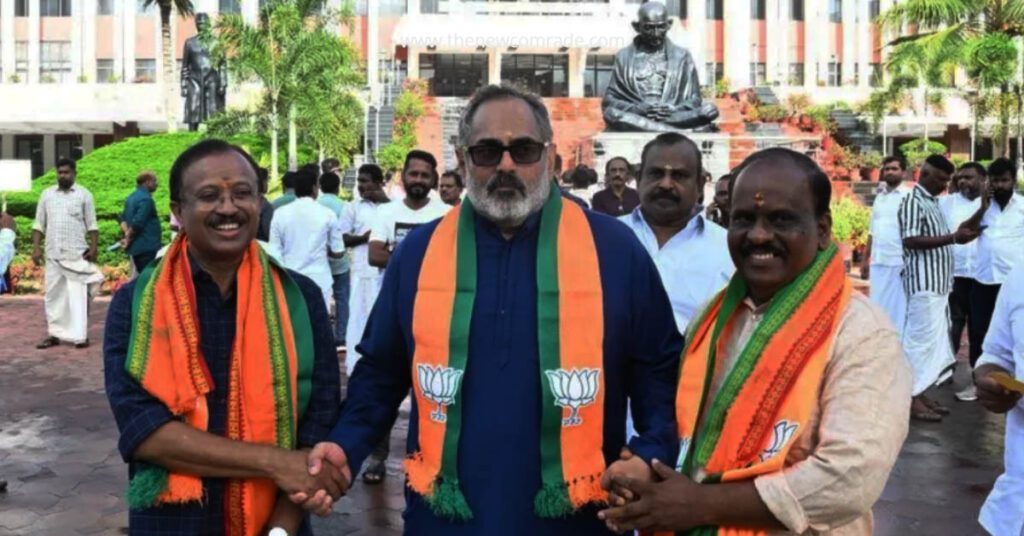
Building on the momentum of the 2024 parliamentary victory, the BJP achieved its most significant civic breakthrough to date in the local body elections held across Kerala in December 2025. In the Thiruvananthapuram Municipal Corporation election, held on 9 December 2025, the BJP won fifty of the corporation’s 101 wards, forming a municipal government for the first time in the institution’s history, with party councillor V. V. Rajesh elected Mayor and Asha Nath elected Deputy Mayor. Rajesh secured the backing of all fifty BJP councillors together with one independent in the mayoral vote, decisively defeating the LDF’s R. P. Shivaji, who received twenty-nine votes, and the UDF’s K. S. Sabarinathan, who received seventeen.
The result ended what commentary at the time described as roughly four and a half decades of unbroken Left control of the capital’s civic body, and it represented a substantial improvement on the BJP’s performance in the previous corporation election, when the party had won thirty-four divisions. Among the most symbolically significant of the party’s gains was its capture of the ward housing the AKG Centre, the CPI(M) state headquarters, a result widely read within Kerala as emblematic of a broader erosion of the Left’s traditional urban strongholds. Political observers at the time were careful to note that municipal results, shaped heavily by local candidate quality and hyper-local grievances such as waste management and civic infrastructure, do not translate in any straightforward or guaranteed way into Assembly-level outcomes, but the Thiruvananthapuram result was nonetheless widely interpreted as a significant indicator ahead of the Assembly election scheduled for the following spring.
The 2026 Assembly Election: A Third Seat and a Wider Landslide
The 2026 Kerala Legislative Assembly election, held in a single phase and counted on 4 May 2026, produced a landslide victory for the Congress-led UDF, which won 102 of the Assembly’s 140 seats, the alliance’s largest mandate since 1977 and a result that brought a decisive end to a decade of LDF government; the Congress alone won sixty-three seats, while the LDF was reduced to thirty-five. Within this overwhelmingly UDF-favourable result, however, the BJP recorded its best-ever performance in a Kerala Assembly election, winning three seats for the first time in the party’s history in the state, a threefold improvement on its previous best of a single seat in 2016.
The party’s three victories were won primarily at the expense of the outgoing LDF. In Nemom, the constituency O. Rajagopal had won a decade earlier, state BJP president Rajeev Chandrasekhar, who had shifted from a national political role to lead the party’s Kerala campaign, defeated the sitting member, V. Sivankutty of CPI-M, by a margin reported at over 3,000 votes, reclaiming a seat the party had lost in 2021 on a campaign built around development themes. In Chathannoor, in Kollam district, BJP candidate B. B. Gopakumar won over the CPI’s R. Rajendran by a margin of over 4,000 votes, a result that gave the BJP its first-ever legislative foothold in the traditionally working-class southern Kerala belt. The closest and most dramatic of the three contests was in Kazhakkoottam, where former Union Minister V. Muraleedharan defeated the sitting CPI-M minister Kadakampally Surendran by a wafer-thin margin of 428 votes. Muraleedharan, who polled 35.39 per cent of the vote against Surendran’s 35.06 per cent, described the result as a genuine policy-driven mandate rather than the personality-and-sympathy-based win that had characterised Rajagopal’s 2016 victory, noting that Kazhakkoottam’s transformation from a largely rural constituency into a technology-sector hub centred on Technopark had reshaped its electorate over the preceding fifteen years.
Elsewhere, the party’s results were considerably more mixed, underlining the continuing unevenness of its support. In Palakkad, long regarded as one of the BJP’s strongest constituencies outside Thiruvananthapuram, state leader Sobha Surendran was defeated by Congress candidate and actor Ramesh Pisharody by a margin of more than 12,000 votes. In the Christian-majority Kanjirappally constituency, Union Minister George Kurian, part of the party’s minority outreach effort, was similarly unsuccessful. The party did, however, put up competitive fights in a number of other constituencies, including Thiruvalla, Kozhikode South, and Kasaragod, without ultimately prevailing in any of them. Overall, the NDA’s state-wide vote share in the 2026 election held at a level broadly comparable with its 2021 and 2024 showings, in the region of eleven to twelve per cent in Assembly terms, indicating that the party’s three-seat gain reflected a more efficient geographic concentration of an already-established support base, aided by the LDF’s broader collapse.
Messaging, Media, and the Development Narrative
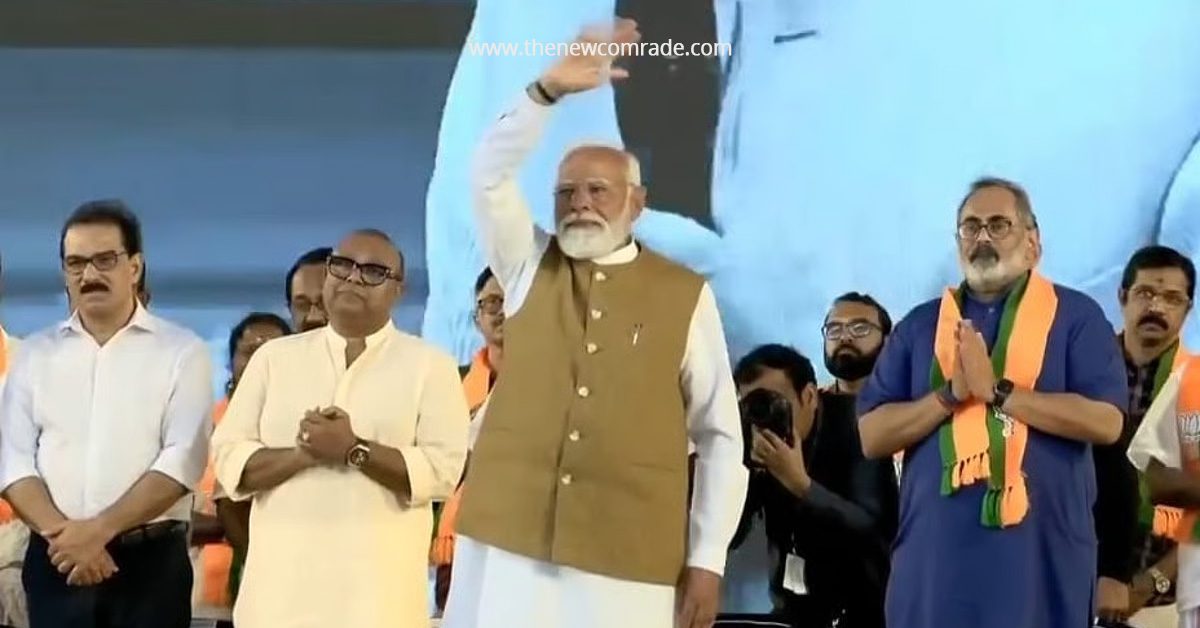
Alongside its organisational and social-engineering strategies, the BJP’s Kerala unit has, since the early 2010s, invested considerably in adapting its public messaging to the state’s specific political vocabulary. Rather than presenting itself in exclusively casteist or community terms, the party has increasingly framed its appeal around governance and infrastructure, a positioning captured in campaign slogans such as “Developed Kerala”, and in the party’s 2026 campaign slogan “the unchanged will change now”. Such messaging sought to position the BJP as an alternative more on the basis of central government infrastructure spending, including national highway expansion, railway modernisation, and some flagship national welfare schemes’ publicity, deliberately contrasted against what party campaigners characterised as administrative stagnation under successive state governments. They have also made increasing use of media platforms aimed at reaching younger, urban voters less embedded in the inherited party loyalties that continue to structure rural Kerala politics, mirroring a broader pattern in the BJP’s national campaigning strategy since 2014. Public appearances by Narendra Modi in the state, including a formal campaign launch from Kochi ahead of the 2026 Assembly election, together with the deployment of high-profile national leaders for targeted state visits, have consistently formed a central pillar of the party’s efforts to compensate for the comparative youth of its Kerala organisation relative to the deeply rooted local networks of the CPI-M and the Congress. The recruitment of high-profile candidates from outside conventional party politics, most notably the actor Suresh Gopi in Thrissur, the retired police officer R. Sreelekha, who won a ward for the NDA in the 2025 Thiruvananthapuram corporation election, further reflects a deliberate strategy of using individual public credibility to offset the BJP’s comparatively thin base of hereditary local leadership in a state where family and community ties have traditionally been central to political mobilisation.
Electoral Performance at a Glance
The table below draws together the principal milestones documented in this paper, illustrating the long gap between the party’s formal establishment in 1980 and its first legislative successes more than three decades later, and the subsequent acceleration of results from 2016 onward.
| Year | Level | Key Result | Significance |
|---|---|---|---|
| 1980 | Formation | Kerala state unit organised under O. Rajagopal and K. G. Marar | Formal establishment of the BJP in Kerala following the Janata Party split |
| 1982 | Agitation | Nilakkal temple agitation | Early template for cross-caste Hindu religious mobilisation |
| 2003 | Communal violence | Marad beach killings, Kozhikode | Fed Hindu consolidation narratives in northern Kerala |
| 2016 | Assembly | O. Rajagopal wins Nemom; statewide vote share approximately 10.5% | First-ever BJP MLA in Kerala |
| 2018-19 | Agitation | Sabarimala protests following Supreme Court verdict | Largest religious mobilisation in the party’s Kerala history |
| 2021 | Assembly | Nemom lost; zero seats; vote share approximately 11.3-11.4% | Vote share rises even as seat total falls to zero |
| 2024 | Lok Sabha | Suresh Gopi wins Thrissur by 74,686 votes; NDA vote share approximately 19.2% | First-ever BJP Lok Sabha seat from Kerala |
| 2025 | Local body | BJP wins 50 of 101 wards in Thiruvananthapuram Corporation; V. V. Rajesh elected Mayor | First-ever BJP control of a major Kerala municipal corporation |
| 2026 | Assembly | Three seats won: Nemom, Chathannoor, Kazhakkoottam; UDF wins landslide majority statewide | Best-ever Assembly performance, within a wider LDF collapse and UDF landslide |
Read across these entries, the pattern that emerges is not one of steady, linear growth but of long plateaus punctuated by sudden, hard-won steps forward, each of which has depended on a distinct combination of national political conditions, local candidate selection, and specific triggering events, whether a religious controversy, a popular celebrity candidacy, or a wave of anti-incumbency against the sitting state government, and above all, implicit but visible support of the state machinery. No single explanatory factor, whether Hindu consolidation, social engineering, celebrity candidacy, or national momentum under Modi, adequately accounts for the trajectory on its own; each has mattered at different points, and in combination with the others, rather than as a substitute for sustained organisational work sustained across more than eight decades.
Structural Challenges and Perceived Weaknesses
The cumulative trajectory traced in this paper, from organisational infancy in the 1940s to three Assembly seats and one Lok Sabha seat in the mid-2020s, represents genuine and hard-won progress for the BJP in a state long considered its most difficult frontier in India. It would nonetheless be a considerable overstatement to describe the party as having broken Kerala’s underlying bipolar political structure. Several persistent constraints continue to define the limits of its growth.
The first and most fundamental is demographic. With Muslims and Christians together comprising close to forty-five per cent of Kerala’s population, and with substantial sections of the Hindu majority, particularly among the numerically dominant Ezhava community and Scheduled Caste groups, remaining loyal to the Left, any electoral strategy premised primarily on Hindu consolidation confronts an arithmetical ceiling that does not apply in most of the states where the BJP has achieved outright dominance. The BDJS alliance and comparable social-engineering efforts represent a considered response to this constraint, but their electoral yield has, to date, remained modest relative to the scale of the challenge. The recent revision exercise of electoral rolls are poised to be aimed at overcoming this ceiling by gradually and eventually disenfranchising the electorate, as they deem necessary.
The second constraint is one of vote efficiency rather than vote quantity. As commentary on the 2026 election observed, the BJP’s aggregate state-wide vote share, at roughly eleven to twelve per cent, is considerably higher than that of the Muslim League, yet the latter’s votes, concentrated geographically in Malappuram, Kozhikode, and Kannur, reliably deliver around fifteen Assembly seats, while the BJP’s more thinly and evenly spread vote share across the state has historically converted into far fewer seats. Translating a rising vote share into a correspondingly larger number of legislative victories will require either a substantially higher state-wide vote share, sufficient to win outright in a broad range of constituencies, or a more deliberate concentration of campaign resources in a narrower set of winnable seats, a tension that has shaped internal debate within the party’s Kerala unit.
A related, and increasingly debated, constraint concerns the durability of the NDA’s newer, non-ideological local alliances. The 2026 partnership with Twenty20, the corporate-backed local party built around the Kitex Group and led by industrialist Sabu M. Jacob, illustrates both the appeal and the risk of this approach: Twenty20 brought a disciplined, well-resourced organisation and genuine local credibility in parts of Ernakulam district, together with a channel into sections of the Christian electorate through Jacob’s own community ties, but its participation in the NDA also exposed the coalition to criticism. Whether such alliances prove durable across multiple election cycles, or dissolve once their specific local utility is exhausted, remains an open question that will bear directly on the BJP’s ability to sustain, or extend, its recent gains.
A third constraint has been organisational factionalism. The state unit has periodically been plagued by rivalries between senior figures and differing regional strategies, disputes over candidate selection, and tension between locally rooted leaders and figures brought in from national roles, dynamics that have, at various points, complicated the disciplined, centralised approach that characterises the RSS itself.
Finally, the party’s efforts at minority outreach continue to sit uneasily alongside its national rhetoric and positioning. Local engagement with Christian clergy or Ezhava community leaders in Kerala can be, and periodically has been, undercut by developments elsewhere in India, or by statements from within the wider Sangh Parivar, as illustrated by the party’s continued difficulty in seats such as Kanjirappally even after years of dedicated outreach.
Kerala for the BJP, electorally, more closely resembles Tamil Nadu and West Bengal, two other states with strong, historically rooted non-Congress, non-BJP political traditions, in which the party’s growth has likewise depended on decades of unglamorous organisational work, tactical alliances with local formations, and the gradual erosion, rather than the wholesale replacement, of pre-existing party systems. The three-seat, single-digit-percentage-point breakthrough achieved in the 2026 Kerala Assembly election is, in this light, broadly comparable in scale and character to the BJP’s earliest legislative gains in West Bengal during the mid-2010s, a useful benchmark for assessing how much further organisational and electoral development might realistically be expected before the party could credibly contest for government in its own right.
Generational change within Kerala’s electorate presents both an opportunity and an uncertainty for the party’s continued growth. Analysts of the 2026 result noted that the BJP performed comparatively well in urban, professionally employed, and Gulf-remittance-linked constituencies where a younger electorate, less anchored to the inherited trade-union and community-organisation loyalties that sustain the LDF and UDF in rural Kerala, proved more swayed by the Hindu nationalist pitch, a pattern visible in the party’s gains around the Technopark-driven transformation of Kazhakkoottam. Measure of deepening of this generational characteristic over successive elections, will be a central determinant of the BJP’s Kerala presence expansion.
The history of the BJP in Kerala is, above all, a case study in the slow conversion of persistence into electoral capital within simultaneously a socio-political system structured to resist exactly that conversion and a State machinery supportive of it. From a single shakha in Kozhikode in 1942, through decades in which the BJS and then the BJP won no seats at all despite contesting almost every election, to O. Rajagopal’s solitary 2016 victory in Nemom, the mass mobilisation of the Sabarimala agitation, Suresh Gopi’s decisive 2024 parliamentary win in Thrissur, the capture of the Thiruvananthapuram Municipal Corporation in 2025, and the party’s three-seat Assembly result in 2026, the trajectory has been one of accumulation rather than rupture. Whether the party’s recent, geographically concentrated gains represent the beginning of a lasting reconfiguration of Kerala’s socio-political landscape, or a further incremental step within a still-dominant two-front system that it has punctured but not replaced, remains, as of mid-2026, an open and closely watched question.
Finally, Kerala’s significance to the BJP extends somewhat beyond the state’s own Lok Sabha and Assembly seats, modest in number by comparison with the largest Indian states. As one of the last major states in which the party has never formed, or come close to forming, a government, and as a state whose literate, internationally connected electorate has often been treated by commentators as a bellwether for the outer limits of Hindu fascist mobilisation in India, continued BJP progress in Kerala carries a symbolic weight for the party’s national leadership that is arguably disproportionate to the state’s numerical weight in Parliament. That helps explain the scale of central resources, senior leadership visits, and high-profile candidate recruitment the party has directed toward the state since 2014, well beyond what its existing seat tally alone might otherwise justify.
-end-