RSS and BJS, 1942-1980
The roots of Hindu fascist politics in Kerala considerably predate the BJP’s formal establishment in 1980. The RSS, the parent organisation of the wider Sangh Parivar, traces its technical presence in Kerala to 1942, when the RSS pracharak Dattopant Thengadi, acting under the direction of the organisation’s national chief M. S. Golwalkar, secured the backing of the Kozhikode royal family to establish the first shakha, or local branch, at Chalappuram in Kozhikode. Growth from this single branch was slow. By the time the RSS was proscribed nationally in 1948, following the assassination of Mohandas Gandhi, the organisation counted twenty-one branches (‘shakhas’) across the territories that would later form the state of Kerala, four of them in the undivided Kannur region. The ban was lifted in 1949 after the RSS agreed to adopt a constitution and formally accept the Indian Constitution and national flag.
The RSS’s political arm, the BJS, was founded nationally in 1951 by Syama Prasad Mookerjee, and it established a presence in Kerala in the same period. From the outset, the BJS in Kerala confronted an impedant environment. The state’s politics were already dominated by an assertive, well-organised CPI and INC that established the backing of powerful community organisations, leaving little space. Early organisational work therefore relied almost entirely on the RSS’s scaffolding of shakhas, cultural events, and social service activity, rather than on any independent political base. Growth of this shakha network was concentrated initially in northern Malabar, particularly in the Kannur, Kozhikode, and Thalassery areas, where a combination of caste dynamics and the RSS’s early institutional presence gave it firmer footing than in central or southern Kerala.
The BJS’s national ideological programme was articulated most systematically by Deendayal Upadhyaya. In Kerala, this framework had to compete against CPI that had already built a formidable political vocabulary around land tenancy law reforms, trade unions, social welfare, etc. and against INC that had secured the loyalty of some of the key caste/community organisations through the practical politics of coalition and patronage. The BJS found comparatively little purchase among an electorate already deeply organised along the alternative axes of class and community affiliation, and the party’s Kerala membership through the 1950s and 1960s remained numerically small, concentrated among urban professionals and trading families, particularly within the Goud Saraswat Brahmin community in towns such as Kodungallur, who had provided some of the RSS’s earliest local activists and full-time pracharaks in the state. The Calicut national session of the BJS, held in December 1967 and at which Deendayal Upadhyaya was elected national president, briefly drew wider public attention to the party’s presence in Kerala, though this visibility did not translate into any comparable growth in the party’s local electoral base.
A crucial and violent dimension of this early history was the RSS’s rivalry with the CPI, which predates the BJS’s own formation. Accounts by RSS chroniclers trace episodes of hostility to volunteers affiliated with the undivided CPI disrupting RSS gatherings as early as January 1948, and to further attacks on RSS meetings addressed by Golwalkar in Kozhikode and Alappuzha in 1949. This cycle of confrontation between RSS-BJP cadres and the CPI (later CPI-M) escalated substantially from the 1970s onward, when the RSS, drawing its early support disproportionately from land- owning caste Hindu communities, came into direct conflict with the CPI-M-affiliated Karshaka Sangham (‘Peasants’ Group’), disputes that were especially severe in the coastal belt of Thrissur district. Kannur district would go on to become, over subsequent decades, the bloodiest single theatre of this RSS-CPI-M conflict, a cycle of retaliatory killing that has claimed hundreds of lives and that continues to shape local political memory.
Despite this sustained organisational and, at times, violent engagement, the Jana Sangh achieved essentially no electoral traction in Kerala throughout the 1950s, 1960s, and 1970s. Hindu fascist activity in Kerala during these decades operated largely outside, rather than within, mainstream electoral politics. The Emergency period of 1975 to 1977 brought a measure of political mainstreaming, as BJS and RSS cadres in Kerala were jailed alongside various other party cadres. The BJS subsequently merged into the short-lived Janata Party that governed India after 1977. That party collapsed over the “dual membership” controversy, in which former BJS members were pressed to sever their continuing ties to the RSS. Rather than comply, they broke away to form the BJP on 6 April 1980, with the Kerala state unit organised shortly afterwards under early leaders including O. Rajagopal and K. G. Marar.
RSS’s own internal understanding of its Kerala mission differed markedly from a narrowly electoral one. Interviews with senior pracharaks recorded by researchers describe a deliberate, long-horizon project of constructing a “Hindu atmosphere,” a phrase capturing the ambition to reshape everyday social and cultural life among Hindu communities rather than simply to win votes. This project proceeded through affiliated organisations covering distinct spheres of society: The Akhil Bharatiya Vidyarthi Parishad (ABVP) among students, Vidya Bharati in education, the Bharatiya Mazdoor Sangh (BMS) among workers, the Bharatiya Kisan Sangh (BKS) among farmers, and, from the 1980s onward, the VHP in the specifically religious domain, together with Seva Bharati’s network of social service and disaster-relief activity. RSS leaders interviewed for this work explicitly framed electoral competition through the BJP as only one, and by their own account not necessarily the most durable, of several parallel fronts, on the reasoning that legislative fortunes are inherently “reversible” from one election to the next, whereas a more thorough-going transformation of society was regarded as offering more permanent change. This helps explain why the Sangh Parivar continued to invest heavily in Kerala, with little or no opposition from the state machinery, throughout decades in which the BJP itself showed almost no electoral progress: the organisational logic driving RSS expansion in the state was never solely, or even primarily, electoral.
The Wilderness Years: Marginality and Cadre-Building, 1980-2000
For the first two decades of its existence, the BJP in Kerala functioned less as a competitive electoral force than as an ideological pressure group whose principal achievement was organisational persistence rather than legislative representation. Kerala’s rigid two-front system left minimal space for a third party: because most constituencies were closely fought between the LDF and the UDF, voters who might otherwise have been sympathetic to the BJP frequently cast tactical ballots for one of the two major fronts to avoid, in effect, wasting their vote, a dynamic that analysts have described as Kerala’s “bipolar trap.” State-wide, the BJP’s vote shares in Assembly elections crept upward only gradually across this period, from roughly two to three per cent in the early 1980s to somewhere in the region of five to six per cent by the late 1980s and early 1990s, without translating into a single Assembly or Lok Sabha seat anywhere in the state. The party’s activities during this period combined electoral participation, however unrewarding, with sustained cultural mobilisation. One of the earliest and most consequential episodes was the Nilakkal agitation of 1982, mentioned before in this series. Cadre expansion continued in parallel: the party and its affiliated organisations worked to build durable local networks even where electoral dividends remained elusive.
O. Rajagopal, who would eventually become the party’s first elected representative in Kerala more than three decades later, exemplified this long pattern of persistence without reward. Rajagopal, who served as the BJP’s Kerala state president from 1980 to 1985 before rising to national roles within the party, contested and lost repeatedly through this period and beyond: a Lok Sabha bid from Manjeri in 1989, and successive defeats from the Thiruvananthapuram Lok Sabha constituency in 1991, 1996, 1999, and 2004, in addition to Rajya Sabha service from Madhya Pradesh between 1992 and 2004, since the party had no realistic prospect of winning a Kerala seat outright. His vote-share nonetheless rose steadily across these contests, from 74,904 votes (10.4 per cent) in the 1996 Lok Sabha election, to 94,303 votes (12.3 per cent) in 1998, to 158,221 votes (20.9 per cent) in 1999, evidence that, whatever the outcome at the ballot box, the party’s underlying support base in urban Thiruvananthapuram was expanding across the 1990s.
The rise of the BJP nationally during the late 1980s and early 1990s, driven substantially by the Ram Janmabhoomi movement centred on Ayodhya, had a more muted and complicated effect in Kerala than elsewhere in India. While the movement helped consolidate the party’s committed core support, it simultaneously provoked some degree of counter-mobilisation from various quarters, a dynamic that further constrained the BJP’s ability to expand beyond its existing base of voters.
Contemporary reporting and later retrospective analysis of the party’s vote share through this period describe a pattern of incremental, almost imperceptible growth that nonetheless proved historically significant in retrospect. Reviews of Election Commission data compiled by Indian news outlets ahead of the 2026 election note that the BJP’s state-wide vote share struggled to cross six per cent through the 1980s and into the early 1990s, before beginning a more sustained, if still gradual, climb from the mid-1990s onward as the party’s national profile under leaders such as Atal Bihari Vajpayee grew, and as the RSS’s expanding shakha network in the state began, slowly, to translate cultural presence into a wider pool of committed BJP voters and, eventually, party workers willing to stand as candidates even in constituencies with little realistic prospect of victory. The party’s practice, sustained across this period and into the following decades, of fielding candidates in a very large majority of the Assembly’s 140 seats at every election, even where individual contests were plainly unwinnable, reflected a deliberate organisational choice: each contested seat, however hopeless, provided an opportunity to register local vote share, identify pockets of latent support, and maintain a functioning local unit that could be built upon at subsequent elections, a slow-compounding strategy whose returns became visible only after three full decades.
Organisational Consolidation and the Turn to Local Governance, 2000-2014
As the twenty-first century began, the BJP’s Kerala unit undertook a deliberate strategic reorientation: rather than relying principally on national ideological campaigns, which had shown limited returns in the state, the party increasingly emphasised booth-level organisation, local governance, and civic issues as a route to gradually establishing electoral credibility. This period saw the systematic build-out of the party’s presence across Kerala’s tens of thousands of polling booths, together with growing engagement in panchayats, municipalities, and municipal corporations, institutions that offered the party opportunities to demonstrate competence in governance and to cultivate future legislative candidates at a scale where the bipolar trap was less absolute than in state or national contests.
Urban and semi-urban pockets, particularly in Thiruvananthapuram and Palakkad, emerged as the principal laboratories for this strategy. In the Thiruvananthapuram Municipal Corporation, the party gradually expanded its ward-level presence through the 2000s and into the 2010s, eventually displacing the Congress-led UDF as the primary opposition to the ruling Left in the capital’s civic body, a position that would prove foundational to its later, much larger, breakthrough in the 2025 corporation election, when the party’s tally of fifty wards represented a substantial advance on the thirty-four divisions it had won in the corporation’s previous election cycle. In Palakkad, a district with a comparatively higher proportion of privileged-caste Hindu voters and a long-standing local RSS presence dating to the movement’s earliest years in the state, sustained municipal-level organisation likewise allowed the BJP to become, over time, one of its most consistently competitive constituencies anywhere in Kerala, a status reflected as late as the 2024 Lok Sabha and 2026 Assembly elections, in which BJP candidates, while ultimately unsuccessful, remained genuinely competitive rather than marginal.
This municipal strategy also served a quieter but equally important administrative function: it provided the party with a training ground for a cohort of local leaders, many of whom had no prior public profile, who could gain first-hand experience of constituency activities, budget management, and coalition negotiation within local councils, skills not readily acquired through cultural or ideological work alone. Political scientists studying party organisation in India have long observed that success in local self-government institutions frequently serves as a proving ground for future legislative candidates, and the BJP’s Kerala unit appears to have applied this logic deliberately, treating panchayat and municipal contests, even those it lost, as a long-term investment in candidate development rather than as an end in themselves.
The RSS’s parallel expansion during this period provided crucial institutional ballast. Kerala paradoxically became host to one of the densest shakha networks anywhere in India relative to its size: national RSS figures for 2016 recorded 6,845 shakhas in Kerala, comparable in absolute terms to states many times its population, and by the mid-2020s the organisation’s own count had risen further still, with reports citing more than five thousand new shakhas established in a single recent count and Sangh leaders describing Kerala as hosting a higher density of shakhas than most other Indian states. This growth was substantial enough that, in March 2024, the RSS took the administrative step of bifurcating its Kerala organisation into two separate ‘pranths’, or organisational zones, to manage the expanded network more effectively. RSS leaders themselves have been candid about the scale of the challenge this expansion represents, given that barely half the state’s population is Hindu and that even within that community a substantial proportion has traditionally supported the CPI and INC factions; one senior Sangh figure overseeing Kerala and Tamil Nadu described the organisation as having been “constrained to work within a small segment and gradually expand”. This organisational depth, built through daily shakha activity, educational institutions, and social work rather than through electoral politics as such, gave the BJP a disciplined and geographically dispersed cadre base on which it could subsequently draw as national political conditions shifted in its favour.
Electorally, this period brought modest but measurable progress. The party’s state-wide Lok Sabha vote share, which had stood at roughly ten per cent in the early 2000s, held broadly at that level through the decade, with the BJP regularly finishing third in a majority of constituencies without seriously threatening either front’s dominance. The 2009 and 2014 Lok Sabha elections saw the party continue to build vote share incrementally without breaking through to win a seat, even as, elsewhere in India, the BJP’s fortunes were being transformed by the emergence of Narendra Modi as the party’s principal national figure. Communal violence in northern Kerala during this decade also fed into the BJP’s efforts at Hindu consolidation, most notably the Marad episode mentioned earlier. The BJP and affiliated Hindu organisations invoked the Marad violence extensively in subsequent years as evidence of what they alleged to be a broader pattern of organised aggression against Hindu communities in Malabar, using the episode to reinforce local recruitment and to sharpen Islamophobic narratives in a district that was already, owing to the long-running RSS-CPI-M conflict described earlier, considerably politically polarised.
Modi Era Begins ; First Legislative Breakthrough, 2014-2016
Narendra Modi’s election as Prime Minister in May 2014 fundamentally altered the resources, visibility, and morale available to the BJP’s Kerala unit, even though the state itself returned no BJP members of parliament that year. National media attention, corporate funding, and an energised cadre base combined to strengthen local organisation, while the party increasingly paired its traditional cultural-nationalist appeal with a governance-and-development narrative built around Modi’s own popularity, an approach intended to broaden the party’s appeal beyond its existing core.
This new momentum crystallised in the 2016 Kerala Legislative Assembly election, in which O. Rajagopal, by then eighty-six years old and contesting for the Nemom constituency in Thiruvananthapuram, defeated the sitting member from CPI-M V. Sivankutty by a margin of 8,671 votes, becoming the first BJP member ever elected to the Kerala Legislative Assembly. The result broke what had, by then, become an entrenched thirty-six-year psychological barrier around the party’s electability in the state, and it was achieved in an election in which the BJP’s state-wide vote share climbed to a new high of roughly 10.5 per cent. Analysis of the result at the time attributed the victory to a combination of Rajagopal’s long-standing personal reputation in the constituency, effective local organisation, and a degree of cross-voting. The 2016 election overall, however, returned the LDF to power under Pinarayi Vijayan with a decisive majority, while the UDF was reduced to forty-seven seats and the BJP’s single seat remained, for the time being, an isolated exception to the state’s continuing two-front pattern.
The Sabarimala Watershed, 2018-2019
If the 2016 Nemom victory demonstrated that the BJP could, under favourable circumstances, win a legislative seat in Kerala, the events surrounding the Sabarimala temple controversy of 2018 and 2019 demonstrated the party’s capacity for large-scale religious mobilisation on a scale unprecedented in the state’s modern political history. The details of this matter have been mentioned earlier in this series.
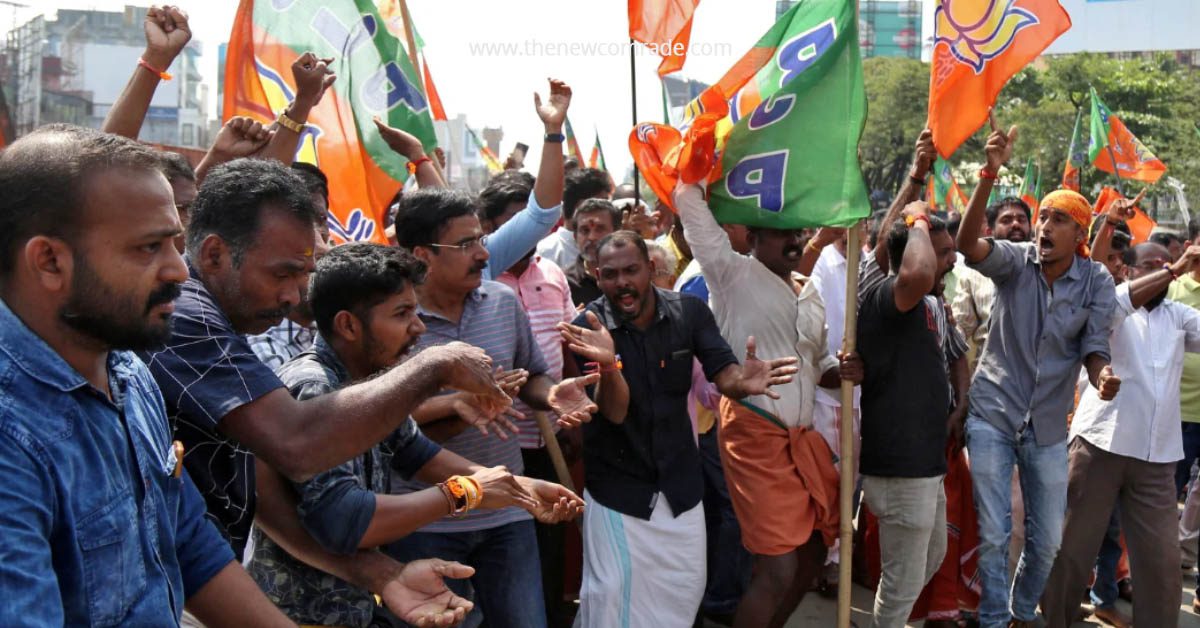
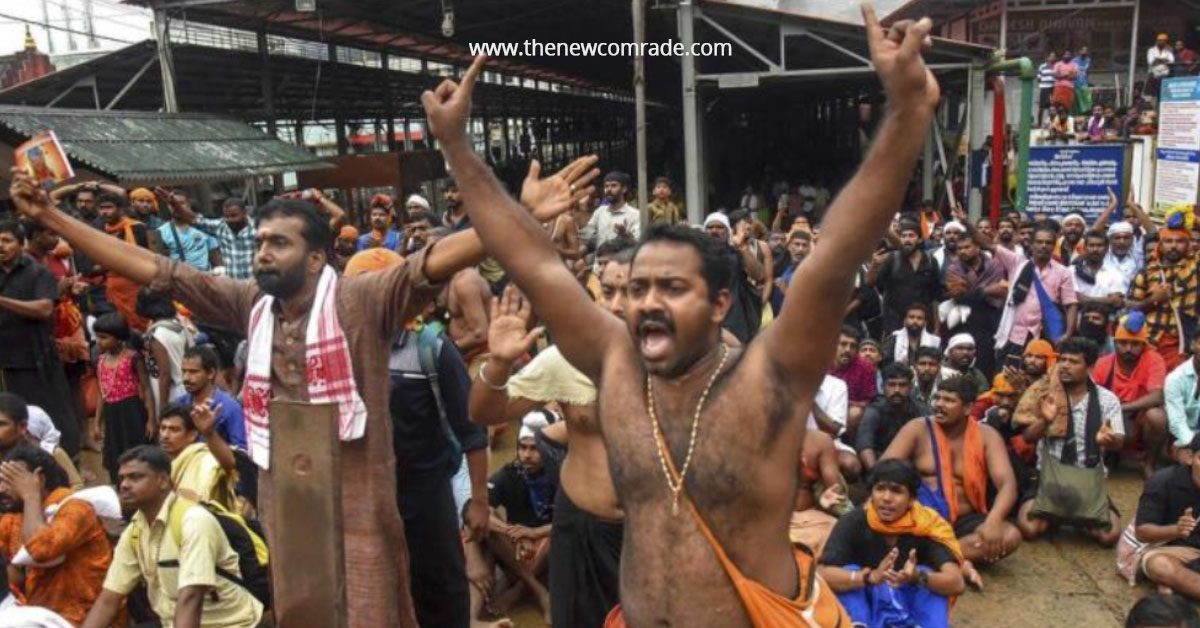
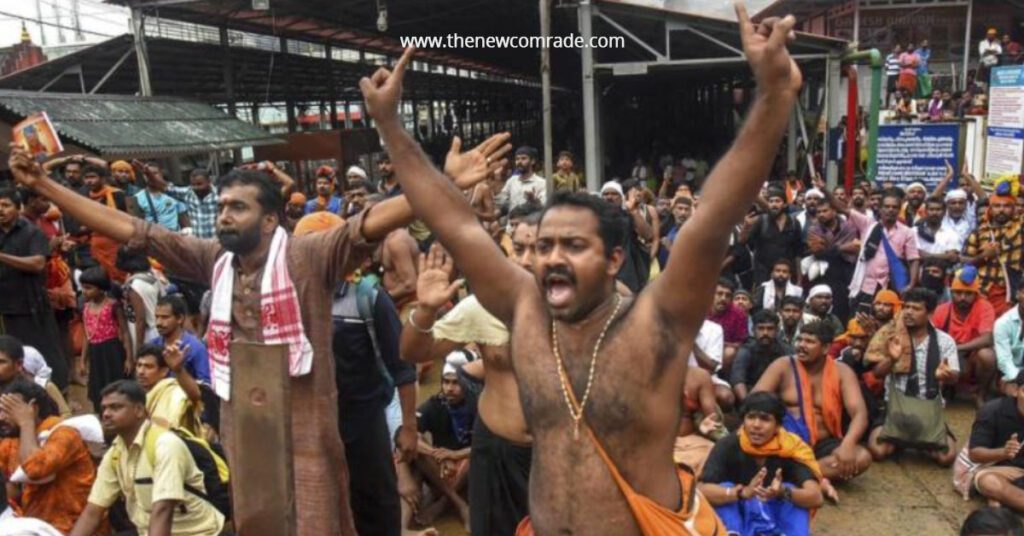
The scale and character of the unrest during the final months of 2018 were, by the standards of Kerala’s usually orderly public life, extraordinary. International media coverage described the state as passing through one of the most violent periods of civil unrest in its recent history. The public rhetoric employed by some BJP-aligned figures during the protests proved excessive by their own standards until then.
The immediate electoral dividend of the agitation proved more limited than the scale of mobilisation might have suggested. In the 2019 Lok Sabha election, held only months after the height of the protests, the BJP again failed to win a single seat in Kerala. Nonetheless, the agitation had lasting effects on Kerala’s political discourse. It normalised open, sustained BJP political mobilisation on fascist lines in an unprecedented manner, drew the party sympathetic coverage across national television networks, and, according to observers writing a year after the verdict, left the BJP’s state leadership continuing to describe Sabarimala as a live emotive issue even as its capacity to mobilise mass cadre action around it visibly declined. Analysts at the time noted that the agitation had exposed the BJP’s growing organisational reach in Kerala.
The 2019 Lok Sabha result in Kerala deserves closer examination in its own right, since it is often cited, somewhat misleadingly, as evidence that the Sabarimala agitation failed to produce any electoral benefit at all. In strict seat terms, the outcome was indeed a disappointment for the BJP: The Congress-led UDF won nineteen of the state’s twenty seats, on more than forty-seven per cent of the vote, while the LDF’s vote share fell from around forty per cent in 2014 to roughly thirty-six per cent. Yet the NDA’s own vote share in the same election rose to approximately fifteen per cent state-wide, its highest level to that point in a Lok Sabha contest, even as it continued to convert into no seats at all. The 2019 result is therefore best understood not as evidence that the Sabarimala mobilisation failed, but as an illustration of the vote-inefficiency problem that would continue to define the party’s Kerala trajectory for years afterward: a rising state-wide vote share, concentrated unevenly across constituencies, proved insufficient on its own to convert into parliamentary or Assembly seats whenever a stronger national or state-level wave favoured one of the two established fronts.
The legal status of the underlying dispute, notably, remained unresolved for years afterward. In February 2020, a nine-judge Supreme Court bench took up a reference arising from review petitions filed against the original 2018 verdict, addressing broader questions about the relationship between religious freedom and constitutional equality that extended well beyond the Sabarimala case itself, including practices such as female genital mutilation among sections of the Dawoodi Bohra community and restrictions on the entry of Parsi women who marry outside their community into fire temples; that reference remained pending years later, meaning that the original 2018 judgment technically continued to govern the legal position even as, in practical terms, the intensity of on-the-ground resistance to its implementation diminished markedly after the 2019 election. This prolonged legal ambiguity allowed each of Kerala’s major political formations to continue characterising the issue according to its own preferred narrative long after the immediate crisis of 2018-19 had passed: the BJP continued periodically to describe itself as the custodian of an unresolved grievance.
The 2021 Correction and the Limits of a Single-Issue Strategy
Despite the heightened visibility generated by the Sabarimala agitation, the 2021 Kerala Legislative Assembly election delivered a temporary setback for the BJP: the party lost the Nemom seat it had held since 2016 and failed to win any Assembly constituency state-wide. The party’s state-wide vote share, however, continued its gradual upward trajectory, reaching approximately 11.3 to 11.4 per cent, a marginal increase on 2016 despite the loss of its sole seat. This pattern, rising vote share accompanied by static or declining seat totals, would recur throughout the following decade and points to a structural feature of the BJP’s position in Kerala: its support, while growing in aggregate, remained more or less geographically dispersed to convert efficiently into first-past-the-post victories against two well-entrenched fronts.
Social Engineering: Ezhava Outreach, the BDJS Alliance, and Christian Engagement
Recognising that a Hindu nationalist party could not realistically secure power in a state where the Hindu community itself is internally divided along caste lines, and where non-Hindu communities together constitute close to forty-five per cent of the population, the BJP’s Kerala leadership pursued a deliberate strategy of social engineering from the mid-2010s onward, aimed at broadening its coalition beyond its traditional base among privileged-caste Nair voters.
The centrepiece of this strategy has been the alliance with the Bharat Dharma Jana Sena (BDJS), a regional party established in December 2015 by leaders associated with the SNDP, historically one of the most reliable components of the Left’s electoral coalition. Formed and led principally by Thushar Vellappally, son of the SNDP’s long-time general secretary Vellappally Natesan, the BDJS entered the National Democratic Alliance in Kerala explicitly to contest seats in constituencies with a significant Ezhava presence, with the stated aim of eroding the Left’s traditional social base. By the 2026 Assembly election, the BDJS was contesting roughly a dozen seats as part of an NDA alliance that, according to political analysis published shortly before the poll, had also come to include ‘Twenty20’, a corporate-backed local party rooted in the Kitex Group and led by industrialist Sabu M. Jacob, whose organisation was seen as offering the NDA a channel into Ernakulam’s Christian electorate through Jacob’s Jacobite Syrian Christian community ties. Parallel outreach to Kerala’s Christian community, though it has yet to produce dramatic shifts in voting behaviour, has become a consistent feature of the BJP’s Kerala strategy over the past decade. This has taken the form of structured engagement with senior clergy across the Syro- Malabar, Syro-Malankara, and Orthodox churches, attempts to address specific community concerns such as the economic difficulties facing Kerala’s Christian-dominated rubber cultivators, and the appointment of Christian leaders, including George Kurian, to ministerial positions at the centre, intended to signal a broader commitment to minority representation within the party. The outcomes of this outreach, however, have remained mixed and unevenly distributed.
The BDJS alliance itself has not been without internal strain. The SNDP, from which the BDJS draws its social base, has historically maintained a formally non-partisan posture, and Vellappally Natesan, the SNDP’s long-serving general secretary and father of BDJS leader Thushar Vellappally, has explicitly distanced the parent organisation from his son’s party’s electoral choices even while implicitly indicating support and sections of the Ezhava community associated with the SNDP have moved toward the NDA. Beyond the formal BDJS alliance, the party has also cultivated a working relationship with the NSS. While the NSS, as an ostensibly non-political body, does not formally endorse candidates, its leadership has periodically made public statements sympathetic to positions closely associated with the BJP, particularly during the Sabarimala controversy, when the organisation’s opposition to the Supreme Court verdict aligned closely with the party’s own campaign.
Beyond community organisations proper, the party and its RSS affiliates have also worked for decades through temple administration bodies and their apex (‘devaswom’) committees, structures that in Kerala carry considerable local social weight independent of formal electoral politics, using such platforms to build relationships with Hindu voters who might not otherwise engage directly with party structures.
Leadership and Organisational Continuity
The BJP’s gradual advance in Kerala has been carried, at each stage, by a relatively small number of long-serving individuals whose careers illustrate the party’s characteristic pattern of sustained effort across repeated defeats before eventual, often narrow, success. O. Rajagopal remains the most emblematic figure in this respect. Having served as the party’s first Kerala state president between 1980 and 1985, he went on to hold national roles including BJP national vice-president and Union Minister of State for Railways, Defence, and other portfolios during periods of BJP-led central government, all while contesting and losing a long succession of Kerala elections before finally winning the Nemom Assembly seat in 2016 at the age of eighty-six, a victory that made him both the party’s first MLA and, at the time, its most senior sitting legislator by age in the state’s history.
Kummanam Rajasekharan, who succeeded to prominence through the RSS’s affiliate organisations before entering electoral politics, served as Kerala BJP state president during the run-up to and aftermath of the 2016 election and later contested the Nemom seat himself in 2021, in the process becoming a prominent public voice on the Sabarimala agitation; his subsequent appointment as Governor of Mizoram reflected the party’s practice of rewarding senior state figures with gubernatorial postings elsewhere in India once their electoral careers in Kerala reached their natural limits. P. S. Sreedharan Pillai, a lawyer by training, likewise combined state party leadership, including the presidency during the Sabarimala protests of 2018, with subsequent service as Governor of Mizoram and later Goa. K. Surendran, a younger leader who rose through the party’s youth wing, went on to serve as state president through much of the late 2010s and 2020s, overseeing the party’s expanded contest of well over one hundred of the Assembly’s 140 seats in successive elections even where individual victories remained scarce.
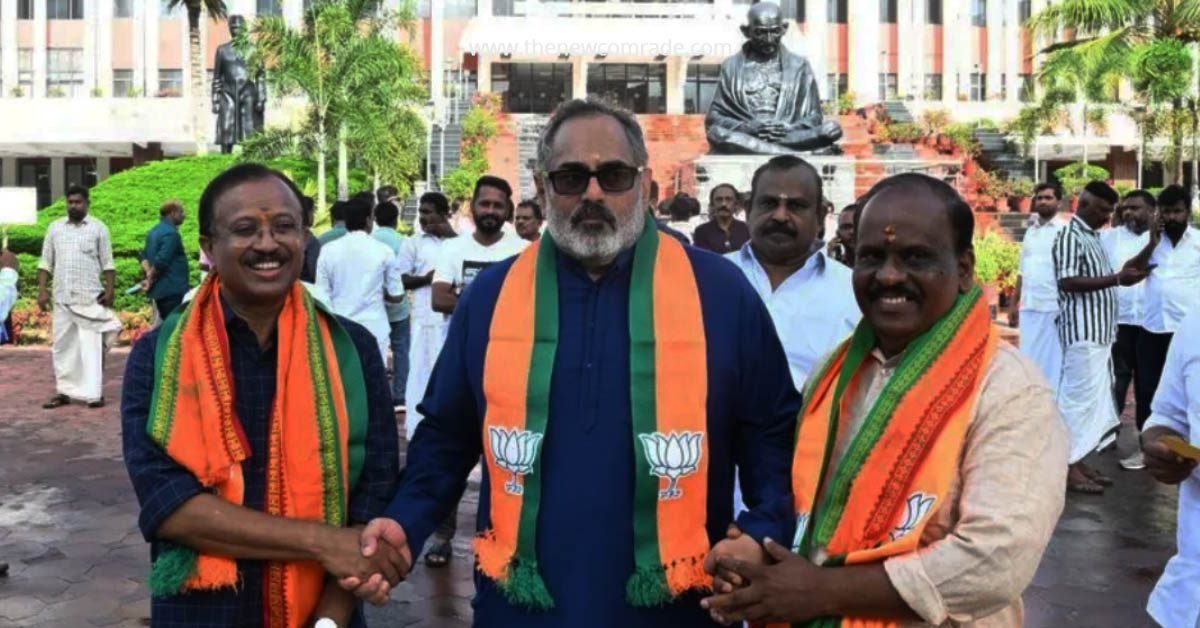
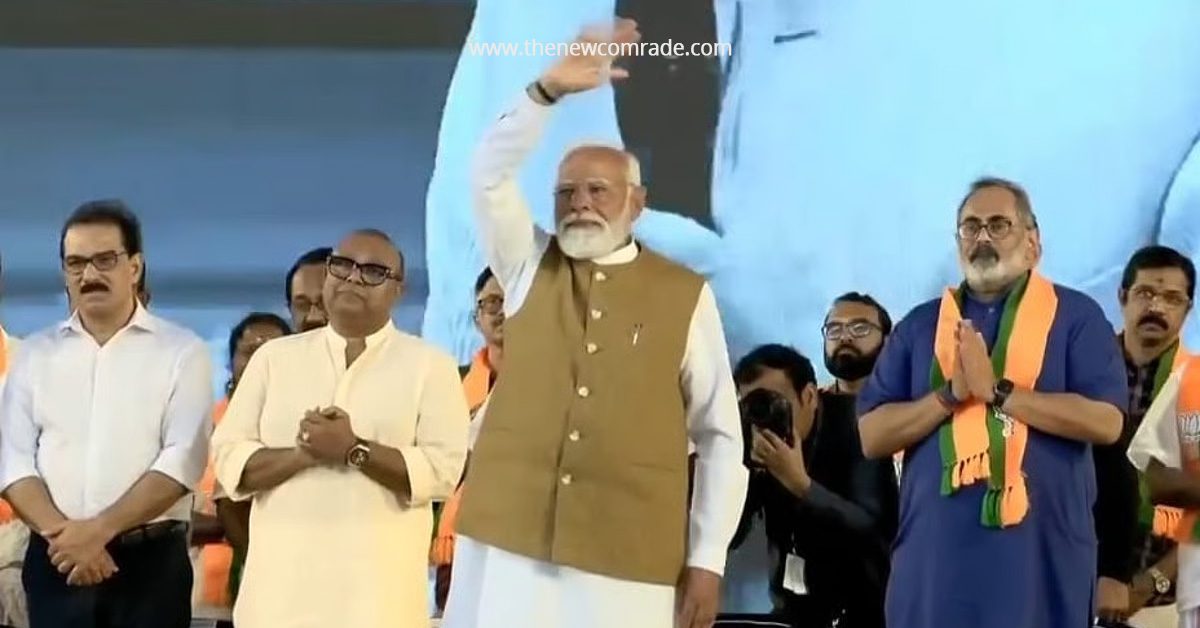
The most recent phase of leadership transition has centred on Rajeev Chandrasekhar, a former Union Minister for Electronics and Information Technology who was appointed Kerala BJP state president in March 2025. Chandrasekhar’s decision to relocate his political focus from a national ministerial role to leading the state unit, and his subsequent decision to contest and win the Nemom Assembly seat in 2026, was widely read as a signal of the national leadership’s increased seriousness about converting Kerala’s accumulated organisational strength into a durable electoral presence, following the model, on a smaller scale, of the Suresh Gopi candidacy in Thrissur two years earlier.
K. Surendran’s tenure as state president through much of the late 2010s and into the 2020s was itself marked by a deliberate emphasis on expanding the party’s formal candidate slate: under his leadership the BJP consistently contested well over one hundred of the Assembly’s 140 seats, including numerous constituencies in which the party had little realistic prospect of finishing even second, on the reasoning, consistent with the organisational logic traced earlier in this paper, that maintaining a functioning local unit and a visible presence at every election was itself a long-term investment regardless of any single contest’s outcome. Surendran also contested and lost the Konni Assembly seat in 2021 and stood unsuccessfully for the Lok Sabha from Wayanad in 2019, part of a broader pattern in which the party’s most senior state figures, including Sobha Surendran, its long-serving vice-president and, in 2026, its Palakkad candidate, have repeatedly stood in difficult constituencies as a matter of organisational duty rather than personal electoral advantage.
(to be continued)